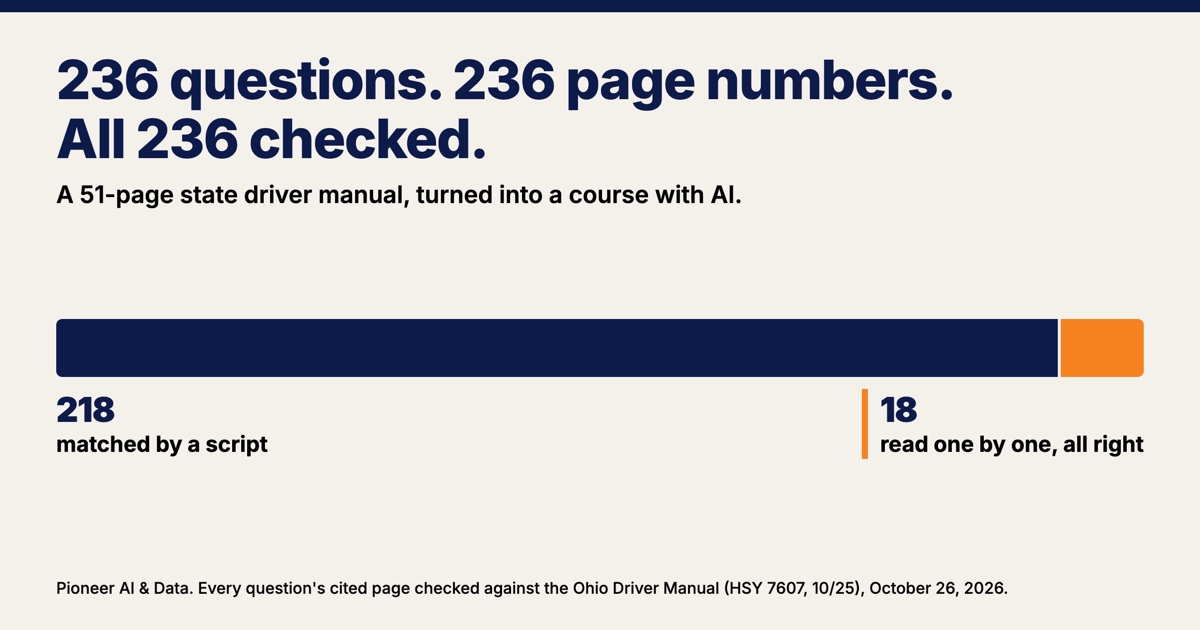
To turn a training manual into a course with AI, give it the manual and ask for three things: units that follow the manual's own sections, questions that each carry a short explanation and the page number they came from, and a practice test built to the same rules as the real one. Then check two things before anyone studies from it: every page number, and every picture.
I did this with a state driver manual, for my daughter. The 51-page Ohio Driver Manual became a course with 12 units and 236 questions, and the first full version took less than an hour. The checks are the part worth reading. A script, then a one-by-one read of everything it flagged, found all 236 page numbers pointing at a page that holds the answer. The pictures needed more work than the text.
Building this kind of thing from a business's own documents, and checking it before anyone relies on it, is part of the AI and data work I do for small businesses. The course is public if you want to click around in it: Ohio Road Ready.
What should a course built from a training manual include?
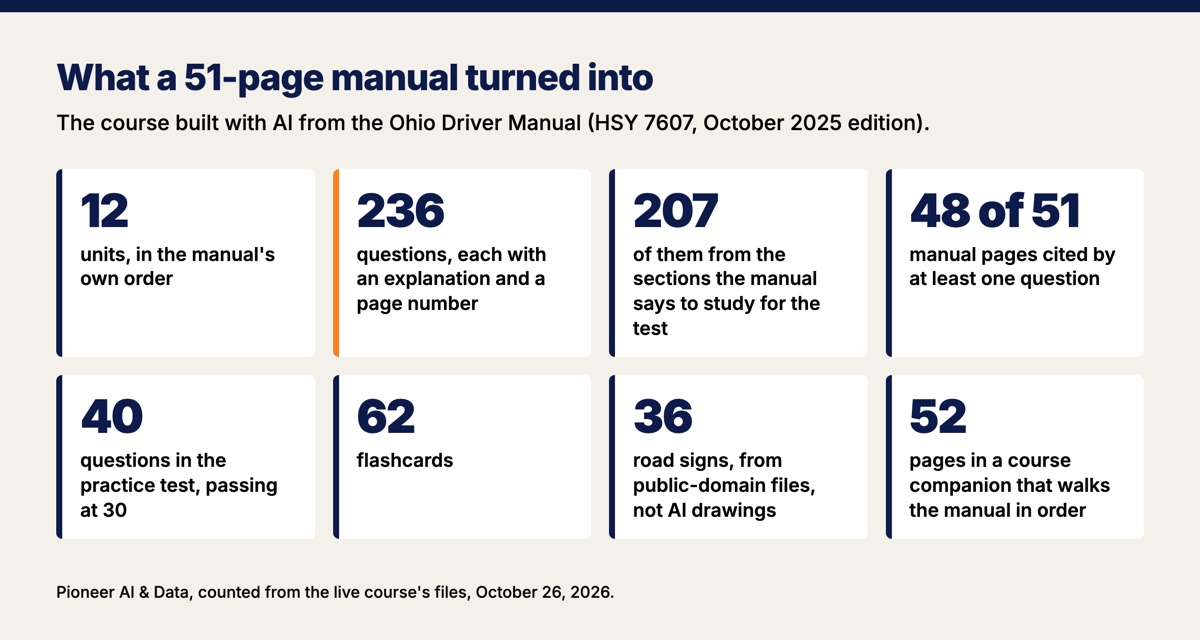
A course built from a training manual should follow the manual's order, test every section, and show where each answer came from. Here is what the driver manual turned into:
- 12 units that follow the manual's sections. Each has the key points, a few check-yourself questions and a short quiz, so a learner can open the manual to the same place.
- 236 questions, each with an explanation and a page number. 207 of them come from Sections 2 through 10, the ones the manual tells you to study for the test, and the 236 together cite 48 of the manual's 51 pages.
- A 40-question practice test built to the real test's rules, which gets its own section below.
- 62 flashcards and a table of numbers to know. Speeds, distances, fines and ages are the details that slip first.
- A gallery of 36 road signs with a sign quiz, because some of what a driver has to know is a picture, not a sentence.
Your manual will not have road signs. It will have something like them, such as the photo that shows the right way to lock out a machine, or the screenshot of the form field everyone fills in wrong. Plan for those from the start, because the pictures are where this course needed the most fixing.
The build itself was fast. In October 2026 I gave a current AI model the manual and asked for "an interactive guide with study questions and quizzes, animations, and video that can help a driver learn." Less than 50 minutes later, the first full version was done. The rest of this post is about the slower part, which is knowing it is right.
Why does every question need a page number?
Every question needs a page number because AI-written questions still contain mistakes, and a page number lets someone who did not write the question check it by reading one page.
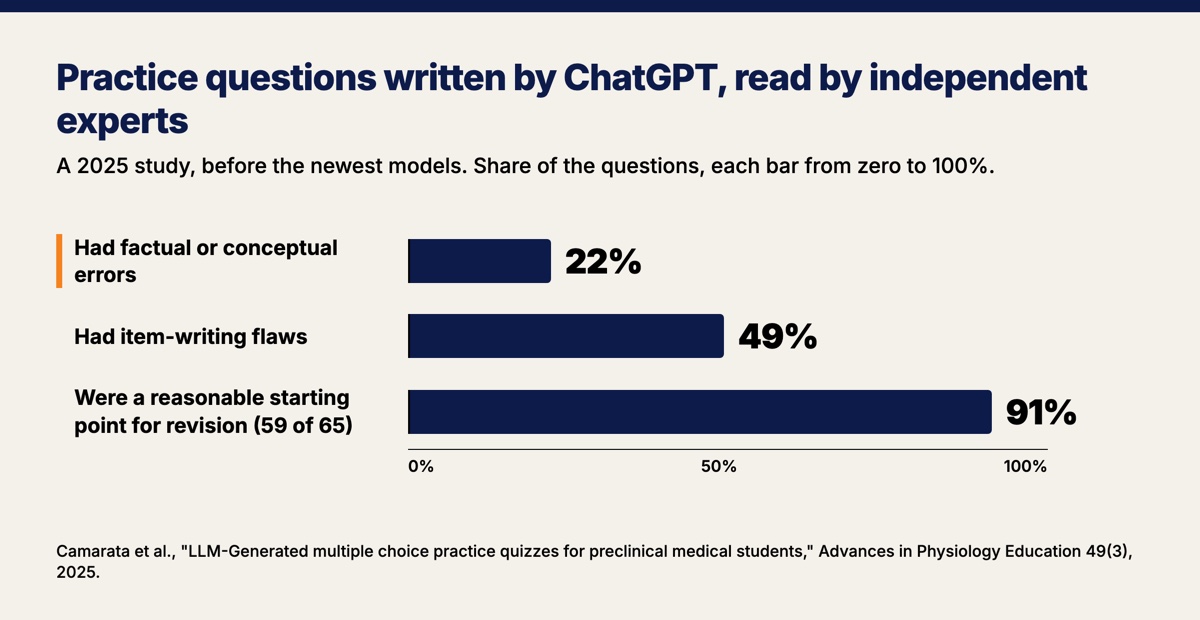
One clear measurement comes from medical schools. In a 2025 study in Advances in Physiology Education, independent experts reviewed practice questions ChatGPT wrote for students: 22% contained factual or conceptual errors and 49% had flaws in how the question was written. Even so, 59 of 65 (91%) were a reasonable starting point for revision. The authors concluded that AI-written practice questions are feasible "only when supervised by a subject matter expert with training in exam item writing."
Has the newest generation of AI fixed the error rate? The newest models look better, and every study cited here still says to check. A systematic review in the Postgraduate Medical Journal in May 2026 covered 71 studies from a search through February 2026, found error rates ranging from under 1% to 45%, and concluded that the evidence "does not yet support unsupervised use" in graded exams. Two 2026 studies tested current models, ChatGPT-5.4 and Gemini 3 among them, on eye-care questions. In one, both models marked the right answer on all 60 of their questions. In the other, experts could use 86.67% to 90% of those two models' questions as written. Both studies still called for expert review. So make every question checkable, whichever model wrote it.
A page number is what makes a question checkable. Without one, checking a question means hunting through the manual for where the answer lives, and in practice nobody does that 236 times. With one, the check is a single page.
How do you check every page number?
To check the page numbers, compare each question's answer against the text of the page it cites, let a script handle the easy matches, and read the rest one at a time.
I had that check run on all 236 questions. The script pulled the text of each page of the manual, then looked on each question's cited page for every number in its answer and explanation, plus at least half of their key words.
- 218 of 236 passed the script.
- 18 were flagged, and each was read against its page, with the page image opened wherever the answer sat in a picture. All 18 were right.
- So 236 of 236 questions cite a page that holds their answer.
The reading was done by the AI session that ran the check, and a separate AI fact checker read all 18 again, plus the 25 weakest of the script's matches, and agreed on every one. A script match is a strong sign rather than proof: one question passed because its page's text names the right sign colors, while only the picture ties blue to gas stations.
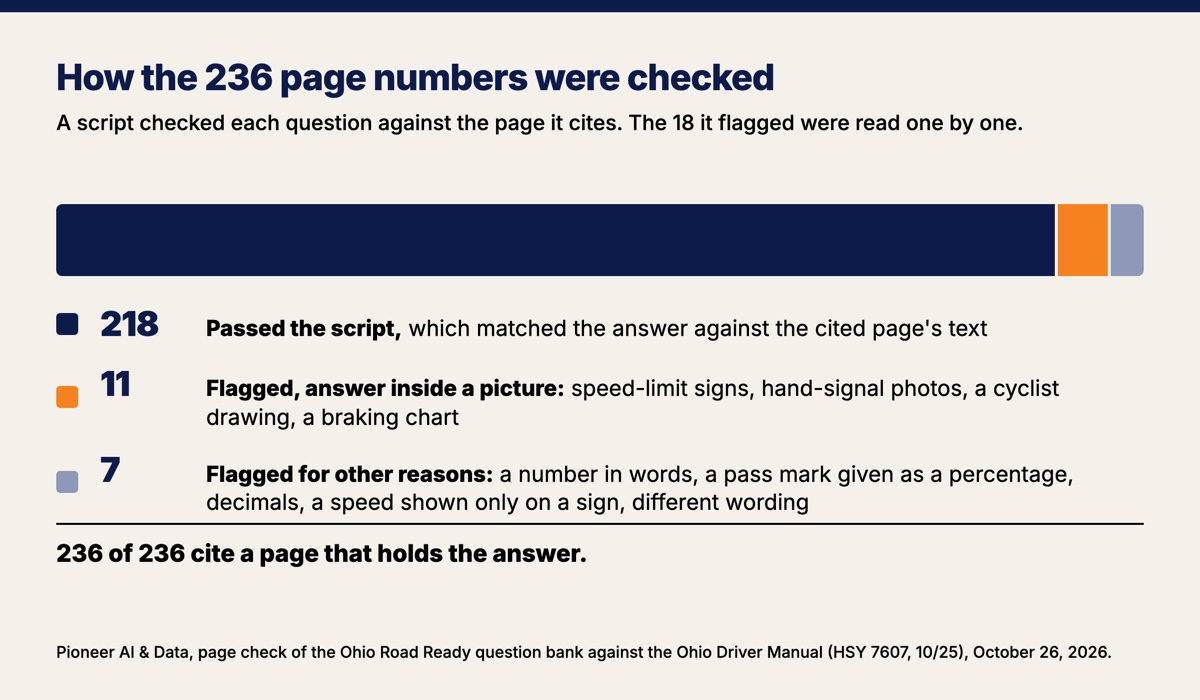
The 18 flags taught me more than the 218 passes. Eleven of them had their answer inside a picture. The manual prints its seven speed limits only on sign images in a table, shows hand signals in photos, shows a cyclist's turn signal in a drawing, and gives a truck's braking distance in a chart. A check that reads only text cannot see a fact printed inside a picture. The other seven were the script's own blind spots: a number spelled out ("six months"), a pass mark of 30 that the page gives only as 75% of 40 questions, three blood-alcohol limits written as decimals like ".08%" that its pattern missed, an answer repeating a 55 mph limit the page shows only on a sign, and an explanation that described the page in words the page does not use.
The 18 flags hold two lessons for anyone checking a course built from their own manual. Facts live in the pictures as well as the text, so expect a text-only check to flag them and read those yourself. And a check like this can show each answer is on its page. It cannot show the wrong choices are good wrong choices, or that each question is the one worth asking. Judging the questions themselves still takes a person who knows the work, which matches what the fact checks on my own posts keep finding: the errors that matter are wrong facts, not awkward sentences.
A drawing of a real thing has to be the real thing
Every picture of a real object in your course should be the real object, not something an AI drew from memory, because a drawing has no page to be checked against.
The first version of the course drew all 36 road signs in code. I asked for an audit of the signs, and it checked every one at full size and at the small size the app uses, plus an automated test for any text running into other text or past a sign's edge. It found faults in 11 of the 36. The railroad crossing sign's two words piled up where the boards cross. Text spilled out of the school speed limit plate. Arrows ran into the red ring on all three no-turn signs. The gas station sign had its colors inverted. All 11 were fixed.
Then came the better question: why draw them at all? Every sign was replaced with public-domain artwork, 34 of the 36 straight from the federal sign standard's numbered designs, with a credit line on the page.
Text and pictures need different checks. A question with a page number can be checked against its page. A drawing of a real thing has nothing to be checked against except the real thing, so use the real thing from the start, meaning the version your learners will actually see. For a business, that means the pictures already in your own manual, or photos of your own equipment and screenshots of your own software. Do not let an AI draw your machine or your paperwork for a training course. A drawing can come close and still be wrong, the way 11 of these 36 were.
Build the practice test to the real test's rules
A practice test should copy the real test's length, coverage and pass mark, so that passing the practice means something on the real day.
The manual spells out its real test: 40 multiple-choice questions with 75% needed to pass, and it points test takers to Sections 2 through 10. So the practice test is 40 questions, at least three from each of the ten units those sections became, and it passes at 30. Every missed question shows its explanation and its page, and a drill re-asks only the misses.
Quizzes are not decoration. In a 2006 study in Psychological Science, students who took tests on a passage remembered more of it two days and a week later than students who restudied it the same number of times, "even though repeated studying increased students' confidence in their ability to remember the material." A 2013 review of ten study methods rated practice testing one of only two with high utility, and rated rereading, highlighting and summarizing low. Rereading feels like learning. Being asked is what works.
For a business, the real test is whatever your sign-off is, such as the safety quiz a new hire has to pass or the checklist a manager walks through in the first week. Build the practice version to match it. If there is no sign-off yet, write the pass rule down before you build anything.
Is a course from your manual worth it for a small business?
A course from your manual is worth building when the manual already exists and new people keep having to learn it, because the manual is the expensive part and you have already paid for it.
Training costs real money. In the Association for Talent Development's 2025 State of the Industry report, built on 2024 data from 539 organizations, those with fewer than 100 employees spent $1,965 per employee on learning, more than medium organizations ($1,195) or large ones ($445). Those are organizations with training staff of their own (the median small one in the report had four), so read the figure as what training costs when it is someone's job. The most common training subjects were new-employee orientation, mandatory and compliance training, and managerial and supervisory training. That is the material that usually already exists in a handbook or a binder of procedures.
A course is a different job from a search box over your files. AI that reads your own documents answers a question when someone thinks to ask it. A course walks a new person through every section, and its practice test gives them a score to show for it.
Two limits are worth saying plainly. The driver course saves progress in the browser on each device, which is fine for one family and wrong for a business that needs a record of who passed. And a quiz proves someone read the procedure, not that they can do it. Hands-on steps still need someone watching.
What to check before your team uses an AI-built course
Before anyone on your team studies from a course an AI built out of your manual, check five things:
- Every question has a page number, and each one has been checked against its page, by a script first and then one at a time for whatever the script flags.
- Every picture of a real thing is the real thing, meaning the picture in your manual or a photo of your own.
- The practice test matches your real sign-off, question count and pass mark included.
- Someone who knows the work has read the questions, not for whether the answer is on the page, but for whether it is the right question to ask.
- You know where the results are kept. If you need to know who passed, the course needs sign-ins, not just a browser.
Building the first version took less than an hour. The checking is the part that makes a course worth handing to anyone.
Want this run for your business?
Book a free discovery call. We map where AI fits, show you the numbers, and point you to the right plan. No pressure, no jargon.
Book a Discovery Call →