AI writing sounds like AI because of a short list of habits: the em dash, "delve," sentences that march in identical shape, a paragraph that ends on a zinger. Those habits are real, and you can strip most of them in an afternoon.
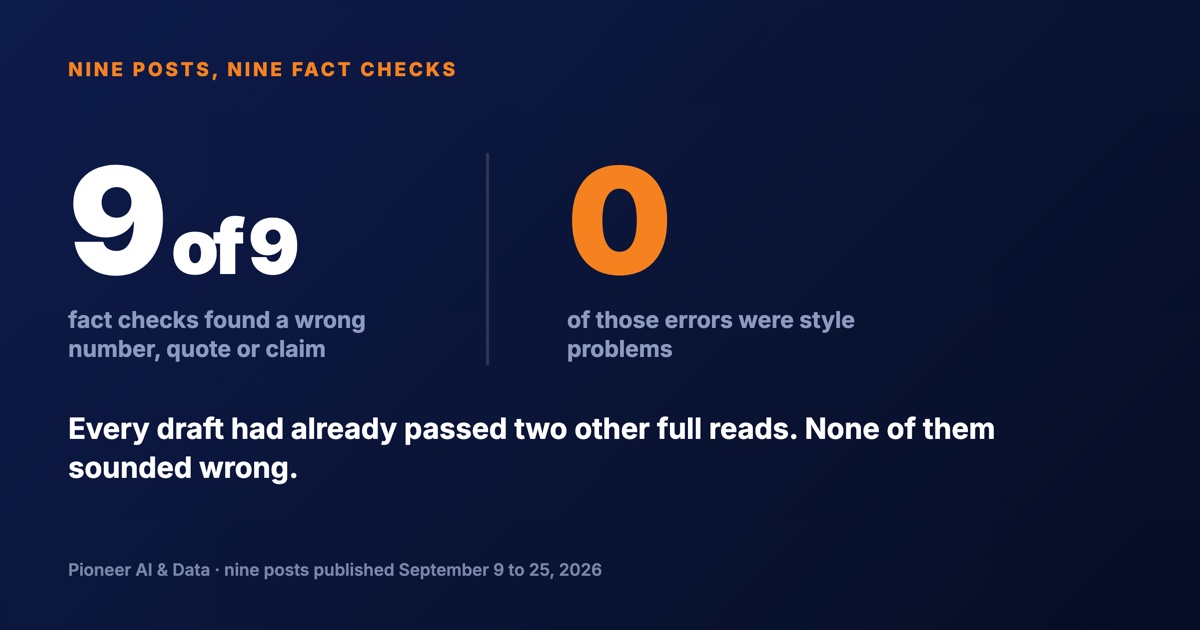
Stripping the tells is the easy half, and the internet has written that half to death. The half nobody measures is the one that will actually cost you something. Across the last nine posts I published, I ran a documented fact check on every draft after it had already passed two other full reads. All nine of those checks found something wrong. A number, a quote, or a claim. Not one of the errors was the kind a reader would have heard.
Getting AI to behave on terms you set is the AI and data work I do for small businesses, and the process below is the one I run on my own writing before I hand it to anybody.
AI writing sounds like AI for a boring reason, and that part is cheap to fix
AI writing sounds like AI because a model builds a sentence one small piece at a time, each piece picked by what usually came next in the material it was trained on. It is reproducing constructions that were common in that material, which is why the same handful keeps showing up: em dashes, "delve," "in the realm of," and the "it's not X, it's Y" construction. I have not seen a verified explanation for why those particular ones win, and for your purposes it does not matter.
Those habits are surface, and surface is cheap to fix. Tell a model not to use a character and it mostly obeys. I measured that on my own hardware: across 381 pages a local model wrote, it produced 13 em dashes in 7 pages after being told not to use them. Told to avoid one character, it almost never used it.
Broad instructions are the ones that slip. On those same 381 pages the model invented 431 links that did not exist anywhere in its source material. It kept the punctuation rule and broke the honesty rule, on the same pages, in the same run.
The habit that survives longest in my own drafts is rhythm. In five of the nine posts, the pass that hunts specifically for machine tells caught sentences marching in identical shape. Four of the five looked like this: three sentences in a row opening with "The report," four consecutive sentences starting "Keep them," a run of "Nine confirm / Seven confirm / Five confirm / Three cover" with the numbers counting down, and a block that went "203 times. 100 times. 10 times."
Every one of those reads fine in isolation. Stacked, they sound like a machine reciting a schedule, and the fix is to restructure the paragraph rather than delete the sentences.
Nobody can reliably detect AI writing, including the company that built the model
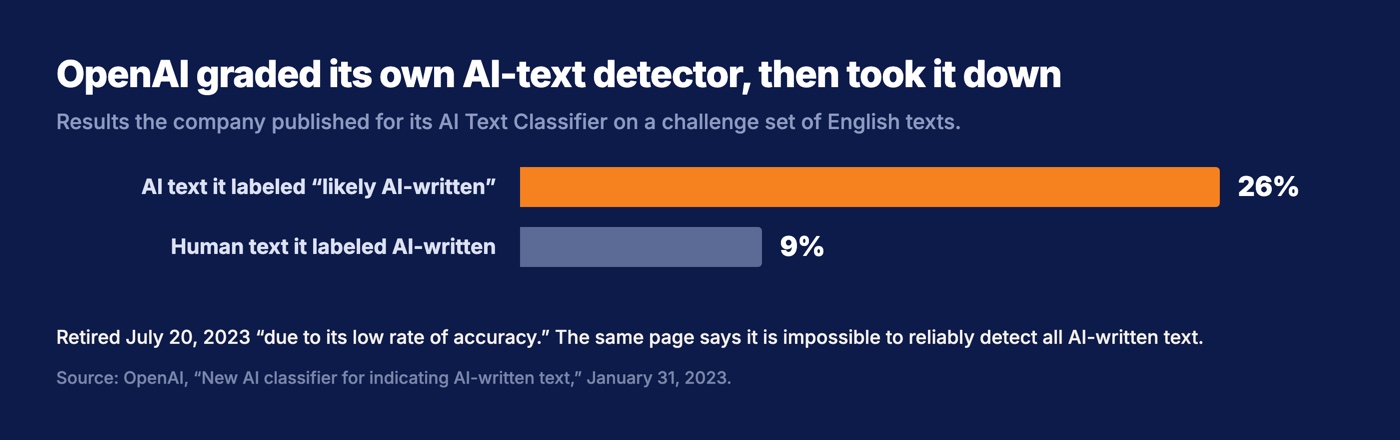
The best-documented public attempt to detect AI text was built by OpenAI, and OpenAI shut it down as too inaccurate to use. The company had the training data, the models, and every commercial reason to get detection right.
The published numbers say why it failed. In OpenAI's own evaluation the classifier "correctly identifies 26% of AI-written text (true positives) as 'likely AI-written,' while incorrectly labeling human-written text as AI-written 9% of the time (false positives)." A false positive here means the tool accused a real person of being a machine. OpenAI took the tool down on July 20, 2023, and the note on the page still reads: "the AI classifier is no longer available due to its low rate of accuracy." The same page concedes that "it is impossible to reliably detect all AI-written text."
Commercial detectors fail in a way that should bother you more. Stanford researchers ran seven widely used detectors against essays they knew were written by people. On essays by non-native English writers, the detectors' average false positive rate was 61.22%, and 89 of the 91 human-written essays were flagged as AI by at least one of the seven. On US eighth-grade essays the same seven detectors were near perfect. The researchers' explanation is that the detectors may penalize writers working with a narrower range of expressions, which is a different thing from detecting a machine.
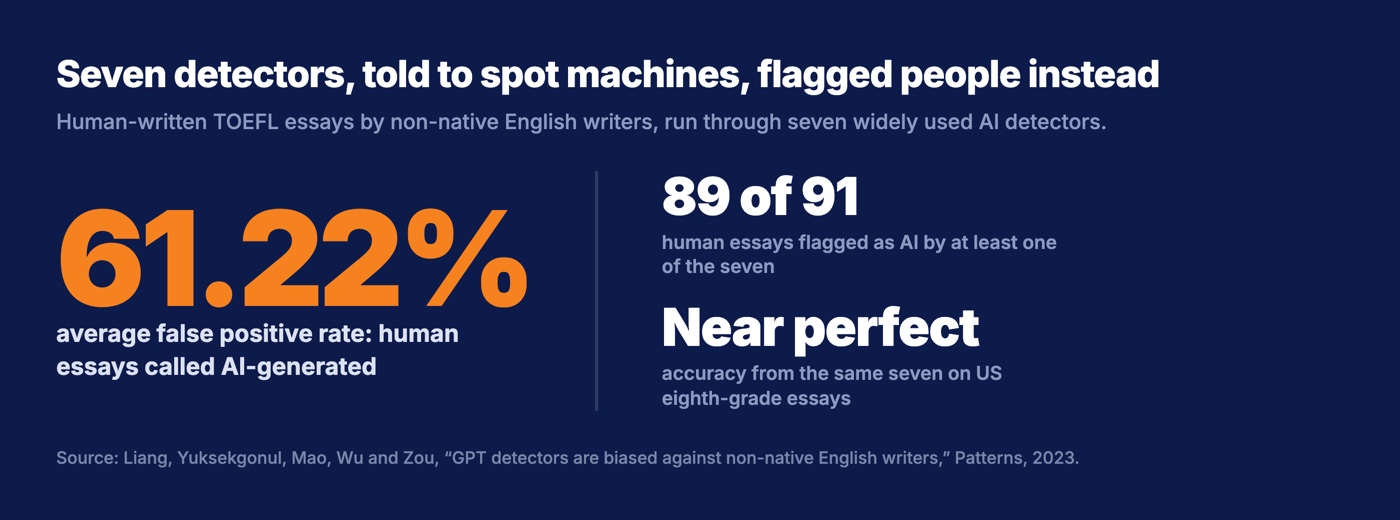
So a detector score is the wrong thing to chase, and there is no single trustworthy score to chase in the first place. Those two figures come from different tools measuring different things. Taken together they establish this much: the best-documented attempt put its "likely AI-written" label on only about a quarter of the AI text it was shown, and seven tools in commercial use flagged the majority of one group of human writers as machines.
Google does not care how it was written. It cares whether it is right
Google has been on the record since February 8, 2023 that it judges the page, not the process, and the wording leaves no room to argue: "Our focus on the quality of content, rather than how content is produced, is a useful guide that has helped us deliver reliable, high quality results to users for years."
From the same page's FAQ: "Appropriate use of AI or automation is not against our guidelines." And the blunt version: "Using AI doesn't give content any special gains. It's just content. If it is useful, helpful, original, and satisfies aspects of E-E-A-T, it might do well in Search. If it doesn't, it might not." E-E-A-T is Google's shorthand for experience, expertise, authoritativeness, and trustworthiness, which is a long way of asking whether the person behind the page has actually done the thing.
What Google does penalize is defined separately, and the definition never names AI as the disqualifier. "Scaled content abuse is when many pages are generated for the primary purpose of manipulating search rankings and not helping users," says the spam policy, which goes on to describe content "that provides little to no value to users, no matter how it's created." A human content farm and an AI content farm break the same rule.
Both documents point the same way. Stop auditing your writing for its production method and start auditing it for whether it is useful and whether it is true.
The failure that costs you is being wrong, not sounding wrong
There is a running public tally of what happens when nobody checks whether the writing is true. Damien Charlotin maintains a public database of court decisions worldwide in which somebody filed AI-hallucinated material, meaning text a model produced that sounded right and was not real, usually a fabricated case citation. As of September 28, 2026 the database holds 2,095 cases.
Two honest caveats belong on that number. The database counts only decisions where a court explicitly found or implied the reliance, so the real figure is higher. And these are lawyers, trained to check citations, filing under their own signature and their own bar license. If it reaches that count among lawyers, the failure is not a competence problem.
Not one of those filings got caught for sounding like AI. They got caught for being wrong. The text read beautifully, which is the actual danger: a model produces fluent, confident, correctly formatted prose whether or not the underlying fact exists. Fluency is not evidence.
Four checks, and what each one actually catches
The process is four separate full reads of the same draft, in a fixed order, each one looking for a single class of problem. Four reads, not one read with four things in mind, because a combined pass finds whatever it notices first and then stops looking.
Pass one: a written checklist, run item by item
The first pass runs a written checklist of 33 items across six sections, read one line at a time rather than from memory. Structure, headings, whether every sentence stands on its own without leaning on the one before it, whether jargon gets defined the first time it appears.
The sentence rule is the one that earns its keep. If an AI assistant quotes one of your sentences out of context, that sentence has to still be true and complete on its own. On one post, ten sentences had to be rewritten because a word like "that," "it," or "ours" pointed back at the previous sentence instead of naming its own subject.
Pass two: voice, read against a written profile
The voice pass reads the draft against a written profile of how I actually write, built from a real corpus of my own messages rather than from what I imagine my style to be. It catches filler, throat-clearing, and register drift.
The voice pass is the softest of the four and I would not run it alone. On one post it cut three sentences that stacked in threes and one paragraph that was arguing with an imagined objector. Real improvements, none of them load-bearing.
Pass three: facts, back to the source every time
Every number, quote, and claim goes back to its source. Not to my notes on the source, to the source. External pages get re-opened in the same session rather than trusted from earlier in the day, and my own numbers get re-queried from the database or log they came out of.
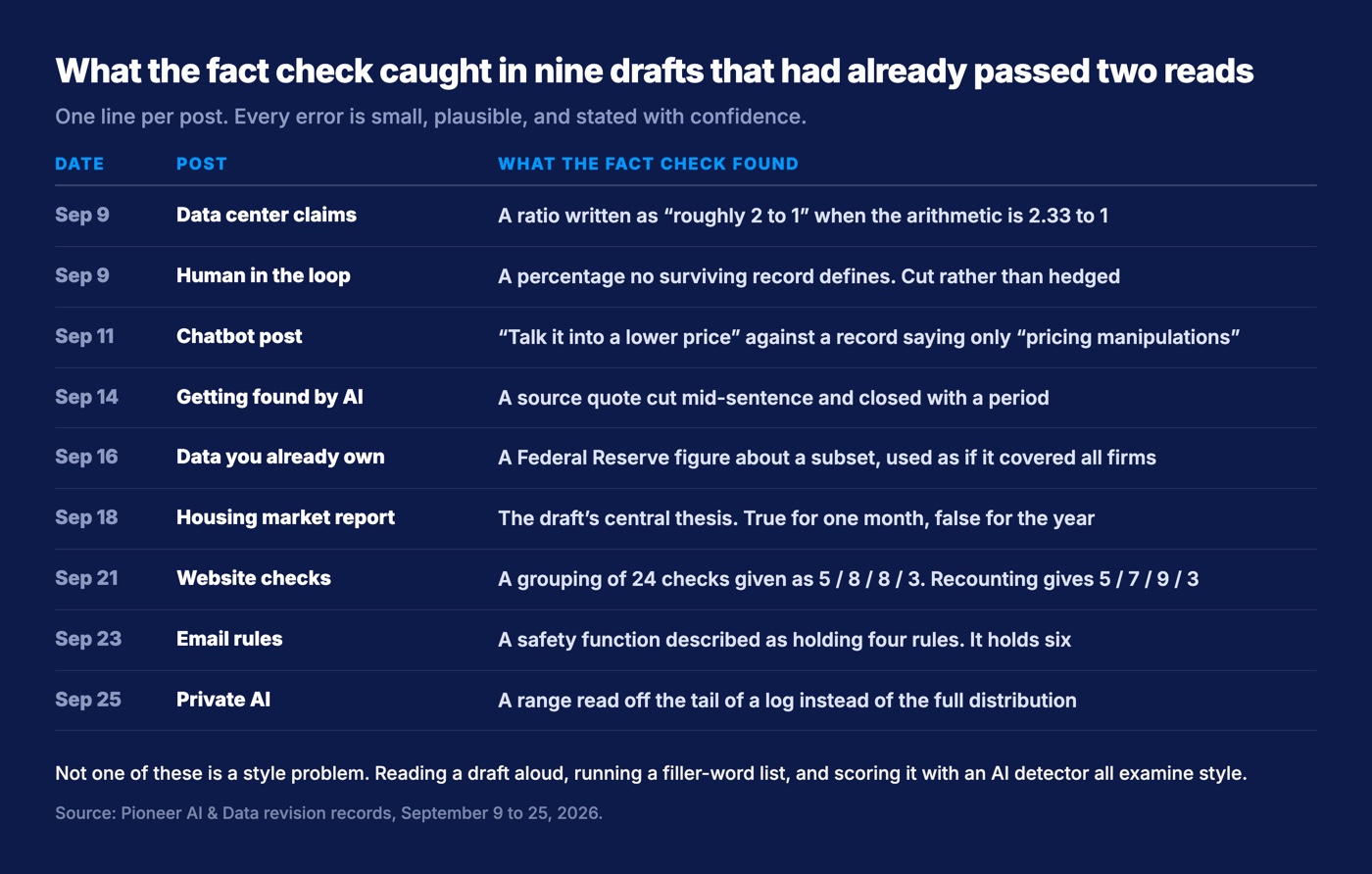
The fact pass is the one that finds real errors, and it found at least one in all nine posts.
The clearest example is the smallest. A draft of mine quoted Google's structured-data guidance, cut the sentence in half, and closed it with a period as if the sentence ended there. It read perfectly. It was not what the source said, because the real sentence continues past the point where my quote stopped. Nothing about the style of that sentence was wrong, so nothing that examines style would have flagged it. The only thing that catches a trimmed quote is opening the page again.
All nine, one line each:
| Post | What the fact check found |
|---|---|
| Data center claims | A ratio given as "roughly 2 to 1" when the arithmetic is 2.33 to 1 |
| Human in the loop | A percentage no surviving record defines, cut rather than hedged |
| Chatbot post | "Attempts to talk it into a lower price" against a record saying only "pricing manipulations" |
| Getting found by AI | A source quote cut mid-sentence and closed with a period |
| Data you already own | A Federal Reserve figure describing a subset, used as if it described all firms |
| Housing market report | The draft's central thesis, true for one month and false for the year |
| Website checks | A grouping of 24 checks given as 5 / 8 / 8 / 3; recounting gives 5 / 7 / 9 / 3 |
| Email rules | A safety function described as holding four rules. It holds six |
| Private AI | A range read off the tail of a log instead of the full distribution |
Read down the right-hand column. Every error in it is small, plausible, and stated with confidence. None of them would have made a reader suspicious. Several of them I would have defended if you had asked me, because I believed them when I wrote them. The one that still bothers me is the safety-function count in the post on what AI does in my inbox, because that draft did not just get the number wrong. It listed four rules as though that were the complete set.
Pass four: the machine tells, and they go last
The machine-tell pass runs last, because it is cosmetic and because running it first tempts you to call the job done. Search the text for every word on the filler list, count the em dashes, then hunt the rhythm problems by reading.
The rule on this pass is restructure, do not delete, because cutting the third sentence out of a symmetric trio just leaves a symmetric pair. The paragraph gets rebuilt or it stays broken.
Four passes were not enough, twice
Twice, a final read after all four passes caught something all four had missed, which is the honest limit on the whole process.
On one post, three bullets were introduced as findings "that no single receipt could have produced," and the middle bullet came off a single receipt. On another, a closing list named five failures in a post that covers six. Both are logic slips rather than fact errors, which is why four passes tuned to other things walked past them.
The stronger fix is not a fifth pass. On the housing report, a separate reviewer who had not written the draft recomputed every figure from the raw files without seeing my work. Every number reproduced. The conclusion I had drawn from those numbers did not hold: the claim was true for one month and false for the year. That correction cost a section rewrite, two rebuilt images, and two rebuilt social cards, and it happened because the checker was not the writer.
A creator should not be the only reviewer of their own work. That rule is older than AI and AI does not change it.
What to do if you are the one signing it
Three things, no tooling required.
Check the facts before you check the voice. If you only have time for one pass, make it this one. Style problems make you sound generic. Fact problems make you wrong in public, and the fluent prose around a wrong fact is what makes it dangerous.
Go back to the source, not to your notes on it. What trips people up is almost never a model inventing something wild. It is a slightly wrong version of something real: a quote trimmed past where it ended, a percentage lifted off the wrong denominator, a number read off the tail of a log.
Have somebody who did not write it read it. A second person, a second session, a checklist somebody else wrote. Anything that breaks the loop where the author is also the judge.
How this post was made, since a reader would fairly ask
AI drafts a lot of what leaves this shop, and the first version of this post was no exception. The four checks exist for exactly that reason, and nothing goes up here until a person has read it and said yes.
Google's own guidance says disclosures "are useful for content where someone might think 'How was this created?'", and a post about checking AI writing is about as clear a case of that as exists. It also says giving AI an author byline "is probably not the best way" to handle it, which I agree with. My name is on this because the judgment calls, the cuts, and the decision to publish are mine.
How I work and what I will not do is written down for the same reason. The checks are not a guarantee. Nine of nine means the process catches errors, and it also means the errors keep coming: every one of those drafts was wrong about something, and the tenth will be too. What the process buys is that the error gets found by me, before the post goes up, instead of by a customer.
Want this run for your business?
Book a free discovery call. We map where AI fits, show you the numbers, and point you to the right plan. No pressure, no jargon.
Book a Discovery Call →