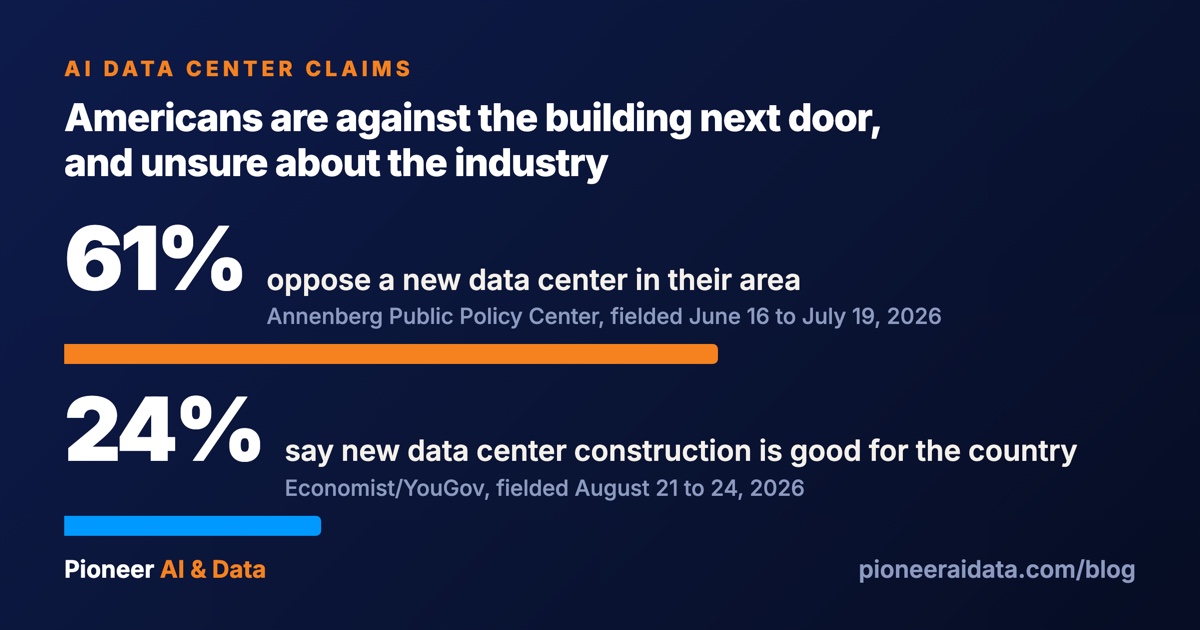
Two national polls landed within weeks of each other this summer and said the same thing. The Annenberg Public Policy Center at Penn found 61% of Americans oppose new data centers in their area, up 12 points from 49% in a February and March survey. An Economist/YouGov poll fielded August 21 to 24 found the same 61% locally, with only 24% saying new data center construction is good for the country.
So the AI data center claims are landing. The useful question is which ones are true.
Here is the short version. Almost all of them are true at the level of the raw fact. The manipulation sits one layer up, in the causal claim and the scale claim. "Data centers use water" is true. "Your data center is why your bill went up" and "China made US AI obsolete" are the payloads.
I sell AI implementation to small businesses in Central Ohio, which gives me an obvious interest in you not concluding that AI is a fraud. That is exactly why everything below has a named source and a year on it. Check them.
Most misleading AI data center claims share one trick: a swapped denominator
Nearly every distorted claim in this fight is a true number with a swapped denominator. That is the whole trick. It runs through all three narratives below, and it runs in both directions.
A figure covering one facility gets presented as a figure covering the industry. A national average gets used to wave off what is happening in one town. On-site cooling gets measured against a rival number that also counts the power plant feeding it. Nobody has to lie. They just have to leave out what the number is a fraction of.
Ranked by how much of each narrative survives that test, here are the three.
Electricity: the most true of the three
The electricity claim has the highest truth ratio, including on causation, which is not what I expected going in.
PJM capacity prices went from $28.92 per megawatt-day in the 2024/25 delivery year to $329.17 per megawatt-day for 2026/27. Monitoring Analytics, PJM's independent market monitor, attributed 63% of the price increase in the 2025/2026 auction to data centers, about $9.3 billion in capacity costs spread across ratepayers. PJM expects that to show up as roughly 1.5% to 5% on customer bills depending on your state and utility.
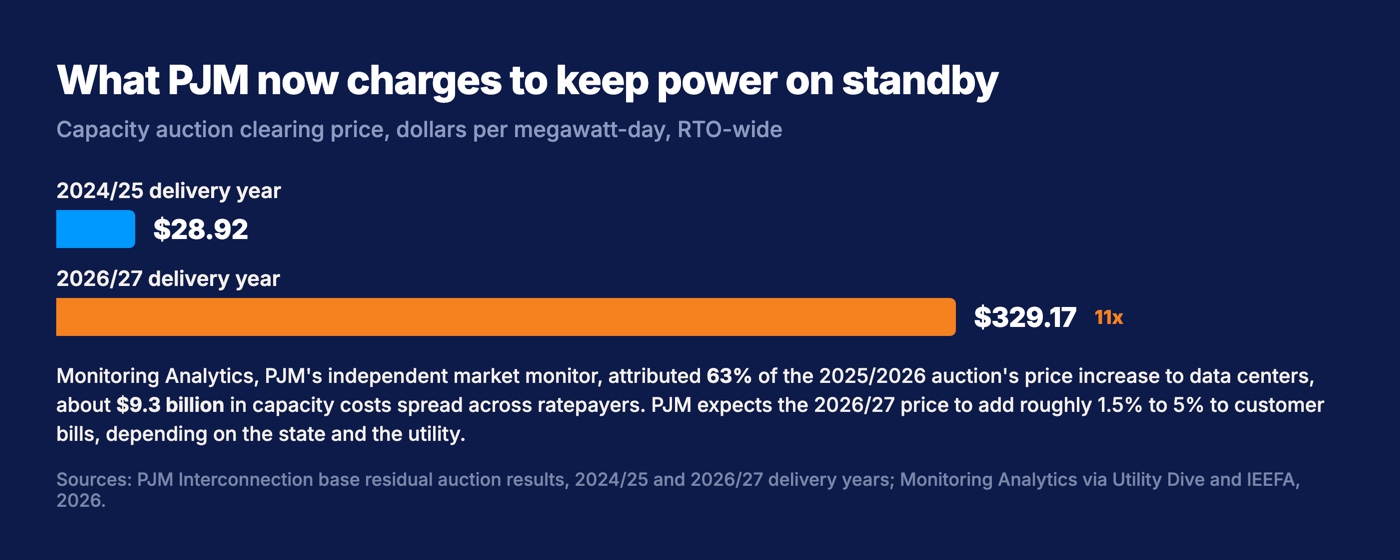
That attribution came from the market monitor, not from an advocacy group. If you live in the PJM footprint and your bill went up, "data centers are part of why" is a supported statement.
Foreign amplification of that story is also real and documented. A CGTN video in October 2025 blamed "energy-hungry data centers that have sprung up due to AI investments" for a "major spike in energy prices." A China Daily piece in March 2026 ran under the headline "AI boom sends electricity bills in US skyrocketing." In June 2026, OpenAI banned two PRC-linked account clusters, one of which it named Data Center Bandwagon, that generated posts and cartoons claiming the AI buildout was raising family electricity bills. The operators prompted in Simplified Chinese over VPNs and posed as Americans.
Now the part that usually gets left off.
OpenAI found no evidence the campaign meaningfully influenced anyone. Its own report says the activity did not break out beyond its own small networks. On August 28, 2026, X disclosed a suspected China-linked bot farm of roughly 200,000 accounts, of which about 200 posted on US AI and energy policy. That is 0.1% of the network. X did not say what the other 199,800 accounts did, how many were automated, when the network ran, how many people it reached, or how it attributed any of it.
Within a day that disclosure was running under headlines about a Chinese bot farm driving the data center backlash. It does not show that. It is 200 accounts and a company blog post. Meanwhile 61% of Americans oppose a local data center, including 54% of Republicans and 69% of Democrats, which is not a number any bot farm produced.
Both things are true at once. A foreign state amplified a real grievance, and the amplification was small, and pointing at it is now the fastest way to tell your neighbors their complaint is not their own.
The honest answer to the electricity question is regulatory, and Ohio already built one. In its data center tariff, PUCO approved a structure requiring data center customers above 25 MW to pay for at least 85% of their subscribed capacity whether they use it or not, on contracts of at least 12 years, with an exit fee of three years of minimum charges. The stipulation behind it was backed by the Ohio Consumers' Counsel and the Ohio Manufacturers' Association Energy Group. The explicit purpose is to keep the cost of building for data centers off everyone else's bill.
That is what an answer looks like. Boring and specific, which is probably why nobody shared it.
Water: real in a town, small in a country, distorted from both sides
The water claim is true locally and small nationally, and both sides of the argument exploit exactly that gap.
Start with the real numbers. Lawrence Berkeley National Laboratory estimated that US data centers consumed 17 billion gallons of water directly for cooling in 2023, plus another 211 billion gallons indirectly through the electricity that powered them. Indirect use was about 12 times direct use, which is a fact almost nobody quoting the direct number mentions.
Local impact is genuine. Google's Council Bluffs, Iowa campus consumed 1 billion gallons in 2024, the most of any of its data centers. In The Dalles, Oregon, Google's data centers used 355 million gallons in 2021, about 29% of the entire city's water. That number is public only because The Dalles spent 13 months in court trying to keep it from a newspaper, lost, and settled by releasing ten years of records.
Now the denominator. All US data centers combined used about 449 million gallons per day, or 163.7 billion gallons a year, as of 2021. Total US water withdrawals run about 322 billion gallons per day per USGS, of which 281 billion is freshwater. That puts data centers at about 0.14% of the total and 0.16% of the freshwater share. I am giving you both because a post about missing denominators should not hide its own.
Both of those pictures are accurate. A national rounding error can still be a quarter of one town's water, because water is a local resource and averages do not flow through pipes.
An infographic circulated in Indiana comparing data center water use to household water use took the 449 million gallons per day figure, which is every data center in the United States, and presented it as the consumption of a single facility. One number, correct at the national scale, relabeled as one building. That is not a rounding error. It is the entire national daily total assigned to a single address.
Pointed the other way, the America First Policy Institute published a paper titled "The Data Center Water Use Hoax" arguing that data center water is under 0.5% of American freshwater use and that there is "no instance of AI infrastructure raising water prices anywhere in America." Its centerpiece is a comparison of Maricopa County data centers, about 900 million gallons expected in 2025, against Maricopa County golf courses at 29 billion gallons. The national share is correct. The golf comparison is also correct as far as it goes. Neither one tells a resident of The Dalles anything about The Dalles.
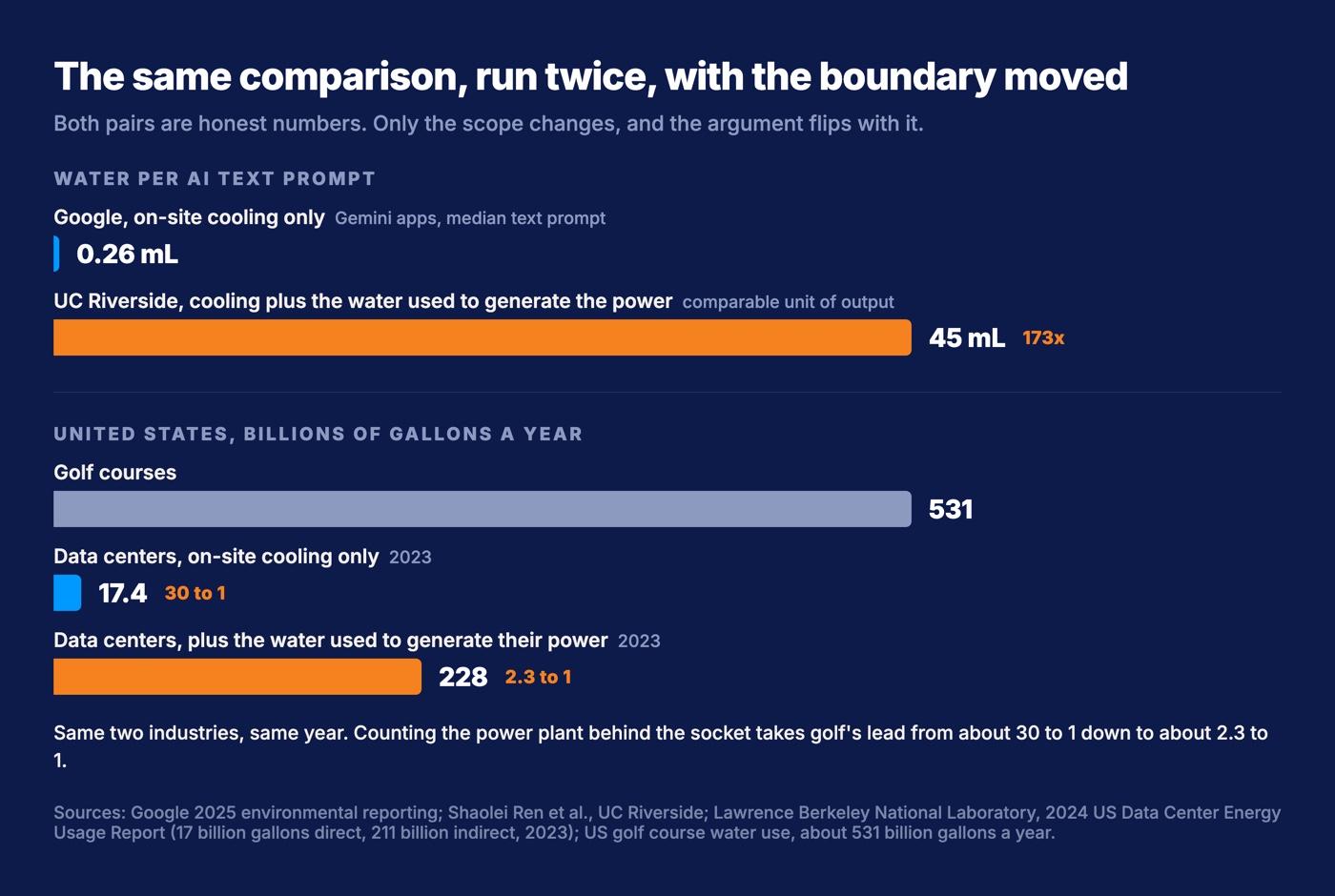
And the golf comparison itself is a scope trick. Nationally, golf courses use about 531 billion gallons a year against the 17 billion used directly by data centers, roughly 30 to 1. Count the water used to generate the electricity those data centers run on and their figure rises to about 228 billion gallons, which turns 30 to 1 into about 2.3 to 1. Same two industries, same year, and the argument flips entirely on where you draw the boundary.
The cleanest example is the bottle meme. Google estimates its Gemini apps use 0.26 mL of water per median text prompt. UC Riverside researchers put roughly 45 mL against a comparable unit of output, and the widely repeated figure is a 500 mL bottle per 10 to 50 responses. That is a gap of roughly 170 times, and it is not a factual dispute. Shaolei Ren at UC Riverside, an author of the cited work, has said as much: the low number counts on-site cooling, the high number adds the water consumed generating the power. Two honest numbers, one missing sentence, and you get either "AI drinks a bottle per question" or "AI uses five drops."
The bubble: mostly organic, and the strongest counterargument just broke
The bubble debate is the least manipulated of the three and the most serious, which is why it belongs last.
The case for a bubble is made by people with no incentive to make it. Bain's Global Technology Report in September 2025 calculated that AI companies need about $2 trillion in annual revenue by 2030 to fund projected compute demand, and will likely fall about $800 billion short. Torsten Slok at Apollo put it plainly: "The difference between the IT bubble in the 1990s and the AI bubble today is that the top 10 companies in the S&P 500 today are more overvalued than they were in the 1990s." Sam Altman said in August 2025 that AI could be in a bubble, which is a strange thing to say if you are running the bubble.
China's angle here is narrower than in the other two narratives, and worth naming precisely. It is not "there is a bubble." It is "we popped it." DeepSeek reported end-stage training costs under $6 million and prices its flagship model's output at $0.87 per million tokens against a $30 list price per million at a US frontier lab. The claim built on top of those real numbers is that American capex is obsolete. That does not follow. Cheap models and expensive infrastructure are not the same market. Making inference cheaper has so far increased how much compute people buy rather than shrinking it, though that is an argument about behavior and not a measurement, so hold it loosely.
The no-bubble case is also real. Jensen Huang argues demand is booked rather than speculative, that compute is sold out, and that the world does not have close to enough data centers for what is being built toward. He also said "this time is different," which is the oldest sentence in finance, and I would not put it in a prospectus.
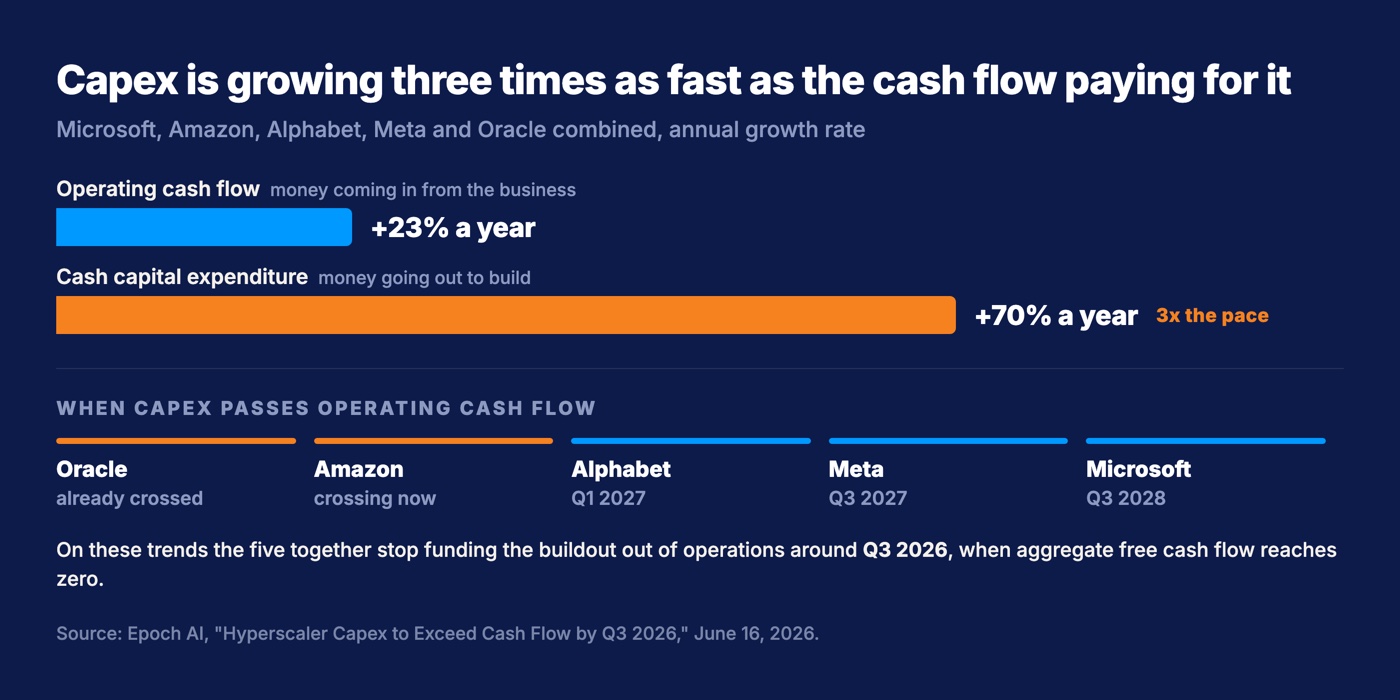
The strongest pillar of the no-bubble case was that hyperscalers were paying for this out of operating cash flow rather than debt. That pillar is gone. Epoch AI's June 2026 analysis has aggregate cash capex across Microsoft, Amazon, Alphabet, Meta and Oracle overtaking operating cash flow around Q3 2026, with operating cash flow growing about 23% a year and cash capex about 70%. Oracle has already crossed. Amazon is crossing now. Incremental annual debt went from 9% of capex in FY24 to 32% by mid-2026, and Alphabet priced an $84.75 billion equity raise in June 2026.
If you want to worry about something, worry there. Not about whether AI works, which is answerable by using it, but about the second-tier financing under the buildout: the Oracle and OpenAI agreement at $300 billion over five years starting in 2027 and roughly 4.5 GW, the special-purpose vehicles, the private credit, and how fast GPUs actually depreciate. Bubbles break at the financing layer, not the technology layer.
How to score a claim you cannot check yourself
Ask what the number is a fraction of, then check it against the dumbest possible alternative explanation. Both halves are necessary.
I do this for a living in a different context. Every month I publish a Central Ohio housing forecast that grades itself against what actually happened, and I do not get to edit the score after the fact. Across 225 graded predictions from February through June 2026, the sophisticated ensemble model called the direction of a move correctly 27% of the time. A naive baseline that just assumes next month looks like this month got it right 80% of the time. The fancy model was not slightly worse. It was worse than a coin flip, and it produced clean, confident, credible-looking output the entire time. The full writeup is here, including why complexity fails on thin data.
Nothing caught that except writing the prediction down first and comparing it to reality later.
Apply the same standard to a claim in your feed. What is the denominator? What would the boring explanation predict? Take "data centers are raising my bill." The boring explanation is regional capacity market pricing, and in PJM that turns out to be substantially correct, so the claim survives. "One data center drinks a state's water" does not survive, because someone moved a national daily total onto a single building. As for "China made US AI obsolete," a cheaper competitor entered the market. That is a normal Tuesday, not a collapse.
A claim that survives both questions is worth acting on. Most do not.
What this means for your business
None of this changes the arithmetic on whether AI pays off inside your shop, because that arithmetic was never about the industry.
The median small business spends $2,200 a year on AI, per the SBE Council's February 2026 survey of 517 small employers. That number does not move because a capacity auction cleared high in a state you do not operate in, and it does not move because a research lab in China published a cheaper model. Whether AI pays for you depends on whether it removes hours you can name from work you actually do. That was the test before the polls and it is the test after. I wrote up the real cost numbers, including ours, if you want the full breakdown.
If anything, the current conditions favor a buyer. Cheaper inference means the tools you are looking at get less expensive per unit of work, not more. Vendors under revenue pressure negotiate. A market where everyone is worried about paying for their infrastructure is a good market to be the customer in.
And if a data center is being proposed in your county, do not settle it from your feed. Read what your utility filed, find out whether your state has a tariff like Ohio's that keeps the buildout cost off your bill, and go to the meeting. Local questions get answered locally. That is the part no bot farm and no think tank paper can do for you.
If you want a place to start with AI that does not require an opinion on any of this, our free AI playbook walks through the first steps in plain English.
Want this run for your business?
Book a free discovery call. We map where AI fits, show you the numbers, and point you to the right plan. No pressure, no jargon.
Book a Discovery Call →