Every AI vendor says they keep a human in the loop. Almost none of them say what that means on a Tuesday, when the thing is running and you have a business to work.
Human in the loop means a person makes the final call on the decisions the AI is not allowed to make alone. That is the whole definition. It does not mean a person reads every output. Those two readings sound alike and behave nothing alike. The gap between them is where most AI setups quietly stop protecting anybody. I had to get the difference right on my own systems first, because the AI setups I build for clients are the same ones running my business.
Here is the version I wish someone had given me: the phrase is worth nothing on its own. What matters is which decisions you put behind a person, and you pick those by asking how expensive the mistake is to undo.
What "human in the loop" actually means
Human in the loop describes a system where the AI does the work and a person makes the call. The AI drafts the reply, flags the transaction, ranks the leads, and then hands the decision to a person who can accept it, change it, or throw it out.
The term comes out of process control and aviation, where the loop is literal: a controller reads a sensor, decides, and acts. When the loop runs closed, the machine acts on its own. When a person sits inside it, the machine stops and waits.
The loop is a design choice about specific decisions, not a personality trait of the software. A system is not human in the loop because a vendor put the words in a deck. It is human in the loop where a named decision cannot execute until a person says yes, and it is not, everywhere else.
That distinction matters most for a small shop, because you are the person. There is no review team. Every gate you add lands on your desk.
Why "a person checks everything" falls apart
Putting a person in front of every decision does not make a system safer. It makes a queue, and queues stop getting read.
I learned this on my own inbox agent. It triages business mail, sorts the noise, drafts client replies, and tracks threads where somebody is waiting on me. When I built it, I gated everything: it proposed, I approved, nothing moved without a click.
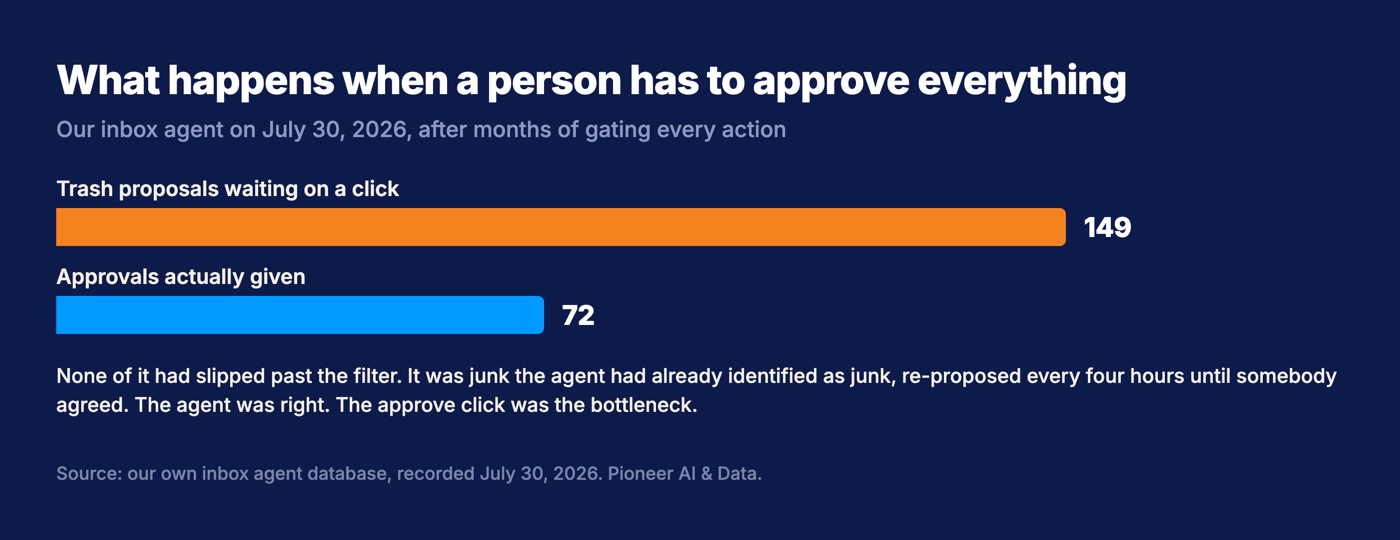
On July 30, 2026 the database showed 149 trash proposals sitting behind 72 approvals. Not junk that had slipped past the filter. Junk the agent had correctly identified as junk, waiting on me to agree. The agent re-proposed every un-approved batch four hours later, so the backlog fed itself. The system was technically perfect and practically useless, and the bottleneck was the approve click.
That was not a discipline problem on my end, and there is research saying so. A randomized experiment with 2,784 participants, published in the Harvard Data Science Review in 2026, tested how people actually behave when reviewing AI output. Requiring corrections for flagged AI errors "reduced engagement and increased the tendency to accept incorrect suggestions." Making the review harder made the reviewers worse. The same study found that attitudes toward AI predicted performance better than any demographic factor: participants skeptical of AI caught errors more reliably, while participants who liked automation showed what the authors call "dangerous overreliance."
That is the part that never comes up in the sales conversation. A human in the loop who is tired, busy, and inclined to trust the machine is not a safeguard. That person is a rubber stamp with a job title.
So the fix for my inbox agent was not to approve faster. It was to stop asking. Obvious noise now cleans itself and reports an undo link in the brief. Only real mail waits on me. The gate moved from "every message" to "the messages where being wrong is expensive."
Sort by how expensive the mistake is to undo
The line is not how confident the AI is. It is how expensive the mistake is to reverse.
I wrote that rule down on July 29, 2026 and it now governs every agent I run. Confidence is the wrong test. A model has no idea what a mistake costs you, so gating on confidence waves through the cheap mistakes and the expensive ones at the same rate. How hard something is to take back, though, you already know without asking anybody. You know which of your emails you would want back.
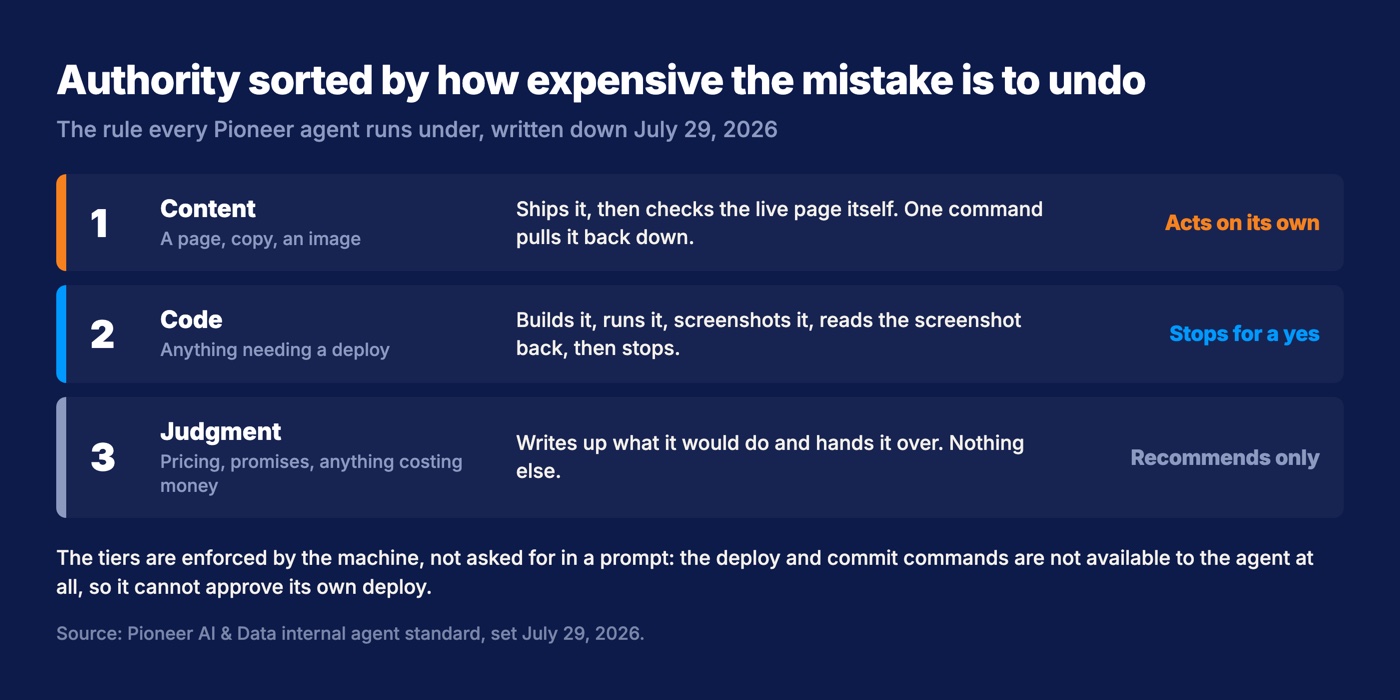
In practice it sorts into three tiers.
| Tier | What it covers | What the agent may do |
|---|---|---|
| 1 | Content: a page, copy, an image | Ships it, then verifies the live page itself. One command takes it back down. |
| 2 | Code: anything needing a deploy | Builds it, runs it, screenshots it, reads the screenshot back, then stops and hands me the exact command. |
| 3 | Judgment: pricing, promises, anything that costs money | Recommends. Never acts. |
The tiers are enforced by the machine, not requested in a prompt. The agent runs with its tooling restricted, so the deploy script, git push, git commit, and the shipping script are not available to it at all. It cannot approve its own deploy even if it decides it should. A rule that lives only in a prompt is a suggestion, and prompts drift.
What that looks like across 24 agents
Twenty-four agents are registered on my fleet page right now, thirteen on a cloud server and eleven on this Mac. They triage two inboxes, back up databases, watch a lead form, build a monthly housing report, assemble a twice-daily reading digest, and test every payment key I hold against the processor once a day.
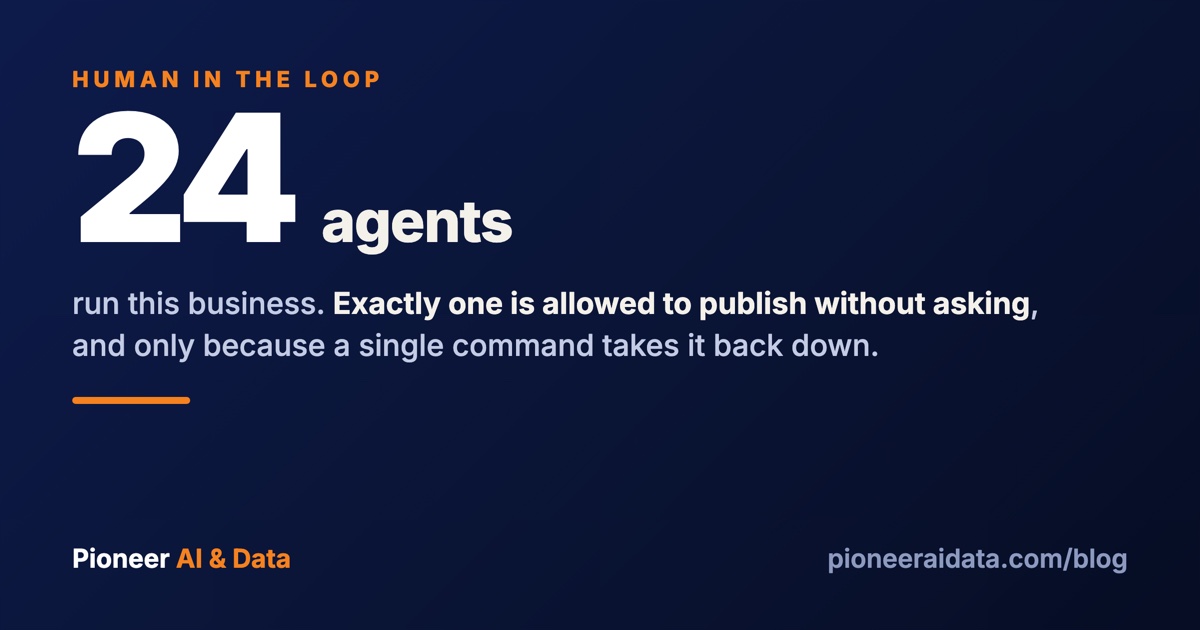
Exactly one of them is allowed to publish anything without asking me first. That is the agent that handles feedback on a client portal, and its permission covers Tier 1 only: content. It ships the page, then checks that the live page and the download actually work, and one command pulls it back down. It got that authority because the undo is cheap and instant, not because I trust it more than the others.
Everything else stops. None of them sends a client an email on its own. The inbox agent writes client replies and never sends them, and where it does not know a fact it writes [NEED: ...] into the draft instead of guessing. None of them deploys code. None of them moves a dollar. The blog post you are reading was drafted by one of the twenty-four on a Monday, Wednesday, Friday schedule, and its entry in my registry ends with the line: never publishes, Jeff approves each post.
There is one more gate worth calling out, because it is the one people get wrong. My inbox agent can permanently silence a sender, which is useful and also the most socially expensive thing it does. That action exists in the code but is deliberately excluded from the list the model is allowed to choose from. The comment sitting above that line says why: closing someone out is a decision about a relationship, not a judgment about a message, "and a model that can infer it would start silencing people on tone alone."
That is what a real loop looks like. Not "a human reviews the output." A specific list of things the machine cannot do by itself, no matter what it concludes.
The two times I got the line wrong
I have set this line wrong in both directions.
Too tight, first. The original rule for my feedback agent was that it could never ship anything. Safe, obviously. It also meant finished, verified, screenshot-checked work sat undeployed for days while it waited on me, which is its own kind of failure. Nobody counts the cost of the thing that did not ship, but the client is still waiting.
Too loose, second. On July 27, 2026 three feedback items were closed against a log line that claimed a reply had been drafted. No draft existed. The client never heard back and the item was marked resolved. The order is now fixed and inseparable: send the email first, then resolve the note, and if the email fails the note deliberately stays open. Two days later I found the portal carrying 304 uncommitted lines of unrelated work in one file, which an ordinary deploy would have shipped along with the fix. Deploys now go through an explicit list of the files that changed, onto their own branch.
Neither of those was an AI problem. Both were gate placement problems, and I only found them because something was writing down what actually happened. That is the same argument I made after grading my own forecasts for five months: a system that cannot tell you when it is wrong is not a system.
What skipping the gate actually costs
You own what your AI tells your customers. A tribunal has already ruled on that question, and the answer was not close.
In February 2024, the British Columbia Civil Resolution Tribunal decided Moffatt v. Air Canada. A customer asked the airline's website chatbot about bereavement fares, the chatbot told him he could apply retroactively, and that was wrong. The airline argued that the chatbot was a separate legal entity responsible for its own actions. The tribunal did not take that seriously: "While a chatbot has an interactive component, it is still just a part of Air Canada's website. It should be obvious to Air Canada that it is responsible for all the information on its website."
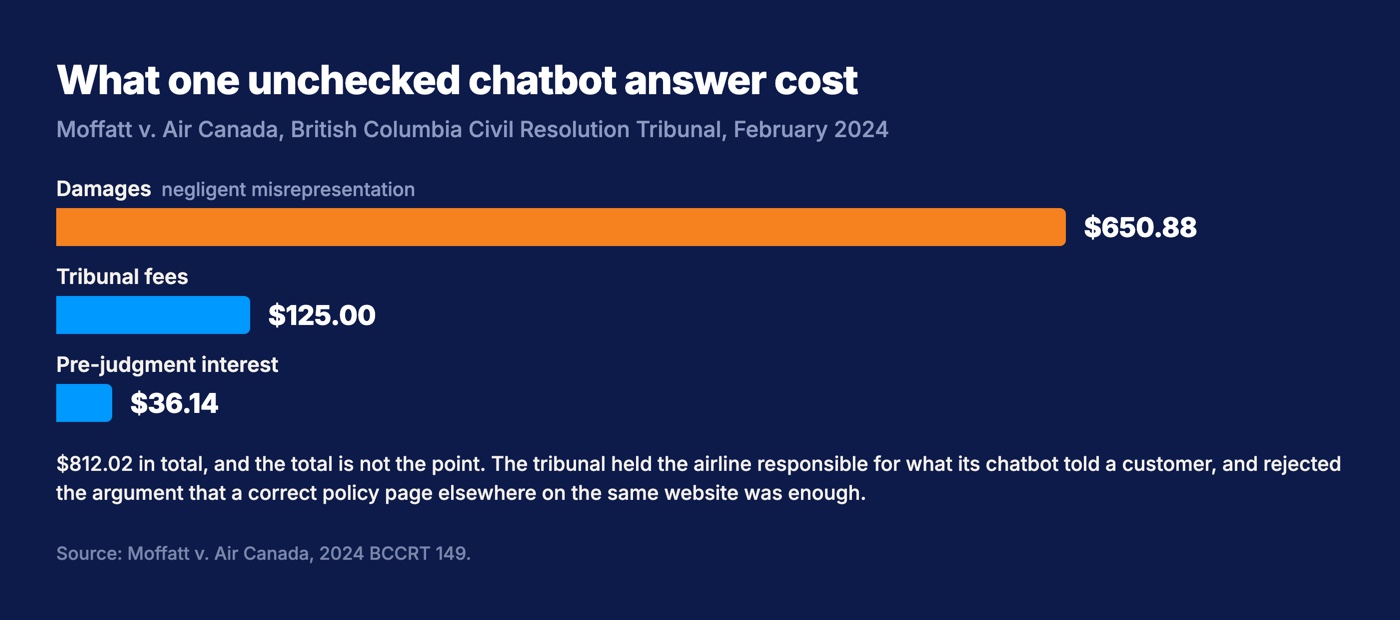
The award was $650.88 in damages, $36.14 in pre-judgment interest, and $125 in fees. Eight hundred and twelve dollars is not what should worry you. The reasoning is. The airline pointed out that a correct policy page existed elsewhere on its site, and the tribunal answered that Air Canada "does not explain why customers should have to double-check information found in one part of its website on another part of its website." Having the right answer somewhere on your site does not cover you when your bot gives a different one.
Regulators are pointed the same way. The FTC announced an enforcement sweep called Operation AI Comply on September 25, 2024, opening with five actions and a line from then-chair Lina M. Khan that leaves little room: "Using AI tools to trick, mislead, or defraud people is illegal." The federal government's own AI Risk Management Framework, published by NIST in January 2023 and voluntary, is built around a GOVERN function covering accountability and oversight. In the EU it is not voluntary at all. The AI Act entered into force on August 1, 2024, and it requires that high-risk systems "can be effectively overseen by natural persons," and specifically that the overseer can override the output, stop the system, and stay "aware of the possible tendency of automatically relying or over-relying on the output." The high-risk rules start applying on December 2, 2027 for stand-alone systems and August 2, 2028 for AI built into regulated products, after an amendment that took effect on July 27, 2026 pushed both dates back.
Look at what that last clause takes for granted: that the person doing the overseeing will be tempted to just go along with it. When a regulation has to name the failure mode out loud, the failure mode is common.
How to draw the line in your own business
Take the decisions your AI touches and sort them by how much it costs to undo a mistake. That is the entire exercise, and it takes about twenty minutes on paper.
Ask four questions about each one.
- If this is wrong, how do I find out? If the answer is "the customer tells me," a person belongs in front of it.
- How long does it take to undo? A blog post comes down in a minute. A sent email does not come back. A refund posted to the wrong account is a phone call and an apology.
- Who sees it before it is final? If the honest answer is nobody, that is a gate you did not know you were missing.
- Am I actually reading these, or clicking through them? Answer that one honestly. If you are clicking through, you have a queue, not a review, and the queue needs to get shorter.
Then set the gates where the undo is expensive and pull them out where it is cheap. A misfiled email, a draft social post, a chart nobody has seen yet: all cheap, none of them worth your morning. A price quoted to a customer, a message sent under your name, a refund pushed to the wrong account: those are the ones you want to touch before they leave the building.
Most small businesses are already running several of these tools. The typical one uses five different AI tools and spends about $2,200 a year on them, according to the SBE Council's February 2026 survey of 517 small employers. An MIT report on enterprise AI last year found that about 5% of pilots produced rapid revenue gains while the vast majority stalled with no measurable impact on the books. The tools are usually not the problem. Nobody decided which calls the machine gets to make.
That is the work, and it is the part I do with clients before anything gets built: name the decisions, sort them by undo cost, and put the gates where they earn their keep. It is also why keeping people in the driver's seat is a published commitment here rather than a bullet on a slide.
Before any of this I spent about twelve years in revenue assurance and fraud analytics at a national wireless carrier, deciding what a suspicious account should and should not trigger. Nobody there called it human in the loop. The rule was just that a flag opened a case for a person to work. It was never an automatic action against a customer, because the cost of being wrong about a customer landed on the customer.
That instinct still holds up. The machine can do the work. Your job is deciding which calls it gets to make, and then not lying to yourself about which ones you are actually reviewing.
Want this run for your business?
Book a free discovery call. We map where AI fits, show you the numbers, and point you to the right plan. No pressure, no jargon.
Book a Discovery Call →