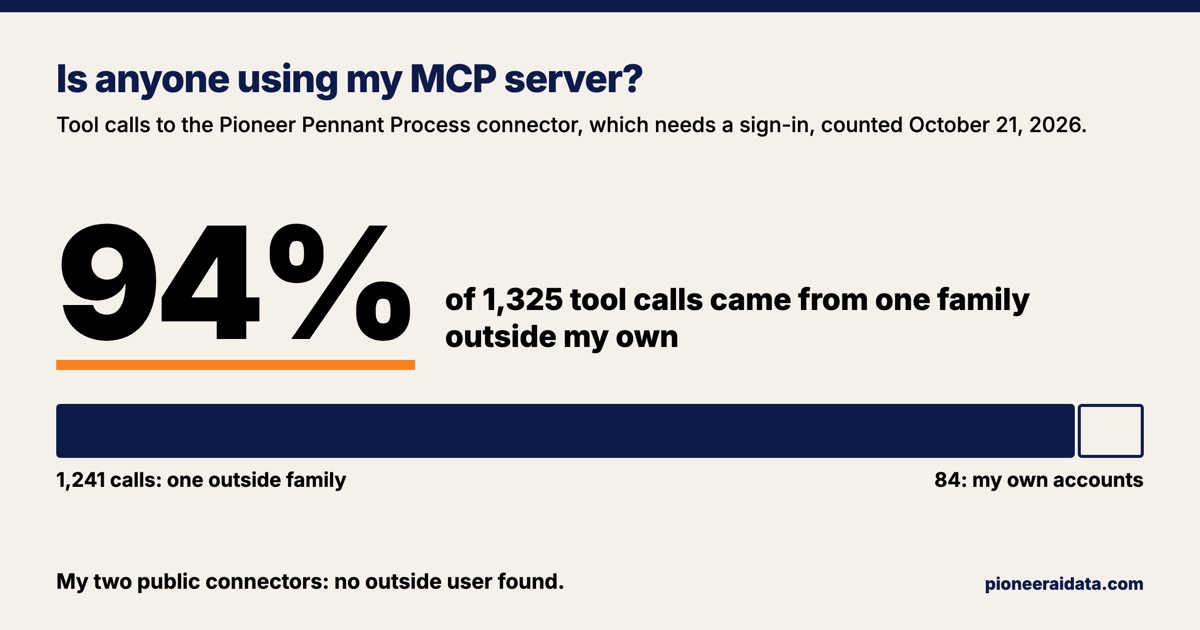
MCP server usage comes down to one number: how many accounts other than yours called a tool in the last 30 days. Your own logs can give you that number only when the connector has a sign-in, because on Claude and ChatGPT every call to a public connector arrives from the AI company's own servers. Without a sign-in, only the AI company can count accounts, and Anthropic does that for connectors listed in Claude's directory. I counted my connectors on October 21, 2026. One family outside my own made 1,241 of the 1,325 tool calls to the connector behind a sign-in, which is 94%. The two connectors anyone can use without signing in had no outside user I could find.
An MCP server, which Claude calls a custom connector, is a small program that lets an AI assistant such as Claude or ChatGPT ask a business's own data a question directly. In October I wrote about building two connectors, and that post ended with no outside user I could point to on the public one. This post is the count that came after, from a read-only report that splits every signed-in call by account and marks my own traffic on all three connector addresses. Checking whether a system gets used, and by whom, is part of the AI and data work I do at Pioneer, and my own products get the check first.
The pages that rank for this question mostly sell the counting: dashboards, gateways and hosted platforms. I did not find one where a small builder published the counts.
Count the accounts that called a tool, not requests or connections
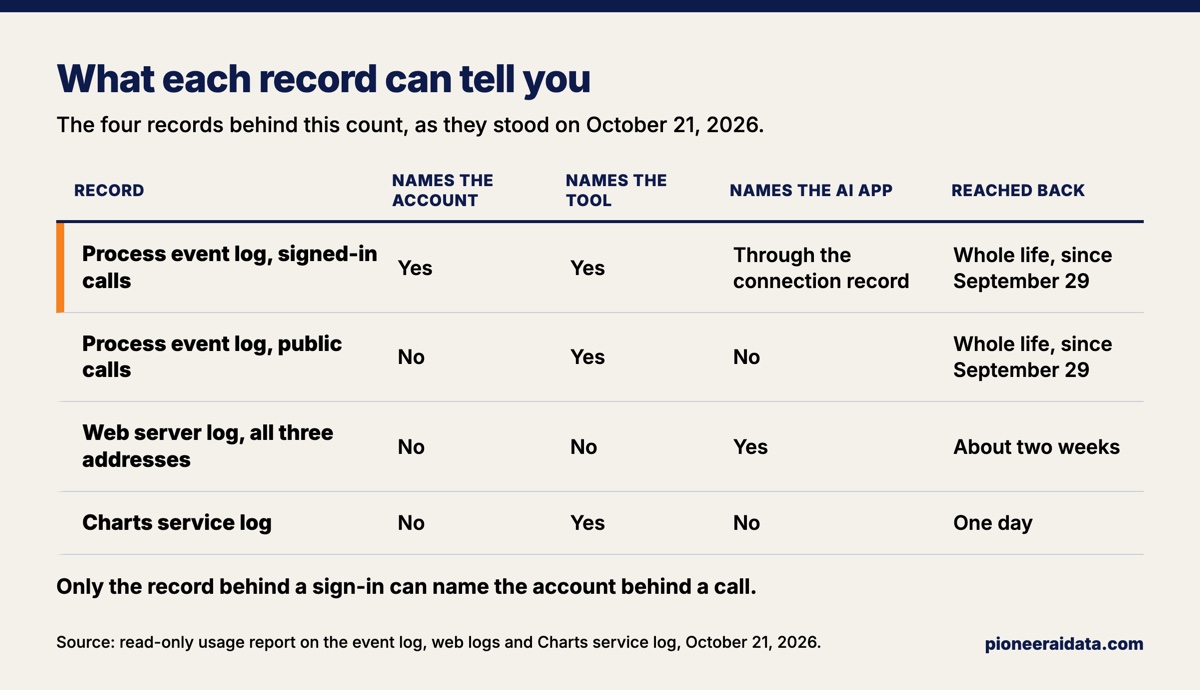
The number that answers "is anyone using my MCP server" is the count of separate accounts that made at least one tool call in the last 30 days. Anthropic reports that count for connectors in Claude's directory on a card called "Used a tool," which its documentation defines as "the number of distinct Claude accounts that made at least one tool call (tools/call) to your server in the last 30 days." The same page adds: "Accounts that only attempted to connect, or connected and browsed your tools without calling one, aren't counted."
A tool call is the message an AI app sends when it asks a connector to do something, such as look up a school. An AI app sends other messages too, including an opening handshake and a request for the list of tools. My usage report puts the gap between requests and calls plainly: "A request is any message to the endpoint (handshake, tool list, or tool call), so requests run higher than tool calls."
Connections are a third number, and most of mine were me. My connector behind a sign-in had four live connections to AI apps on October 21, and three of the four were mine: two ChatGPT connections from directory testing on October 7, and the Claude connection on my family's account. Two more registrations, one from Claude and one from ChatGPT, never went on to a sign-in. An AI app registers with a connector the moment someone adds it, before anyone signs in, so an unfinished registration is either a person who tried and stopped or a leftover from someone who connected on another try. My records cannot say whose those two registrations were.
Without a sign-in, your own logs cannot say who is calling
On Claude and ChatGPT, every user reaches a public connector from the AI company's computers, so the connector's own logs cannot tell one person from another. Claude's help center says: "Claude connects to your remote MCP server from Anthropic's cloud infrastructure, rather than from your local device." Anthropic publishes one block of addresses that it uses "when making MCP tool calls to external servers." OpenAI's list of the addresses its connector servers use held 288 address entries when I fetched it on October 30, 2026.
A web server's log can name the AI app that called and not the person behind it. Each request carries the calling app's label, such as Claude or ChatGPT, and on my two public connectors that label cannot tell my own chats from a stranger's. The address on a request only singles out tools that run on their own machine, which is how my report picked out the test commands I ran from my Mac.
A tool call names the tool and leaves the person out. Under the protocol's specification, a tool call carries the tool's name and its inputs. A sign-in is optional in the protocol and is built on OAuth 2.1, the standard behind most "sign in with" buttons. When a connector has a sign-in, the specification says the sign-in token "MUST be included in every HTTP request from client to server," so a connector with a sign-in knows which account sent each call.
The specification asks the AI app, not the connector, to "Log tool usage for audit purposes." The full record of who asked what sits with the AI company, and the connector's owner sees only what their own logs keep.
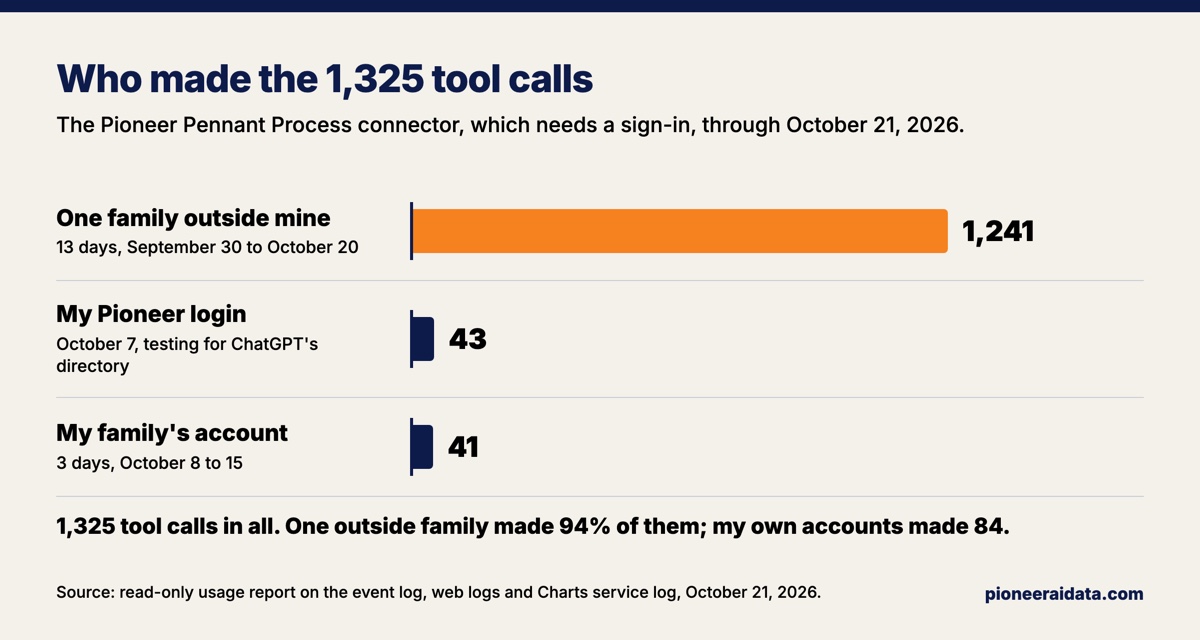
My connector behind a sign-in had one outside user, and that family made 94% of its calls
Between September 30 and October 20, 2026, one family other than mine made 1,241 tool calls to the Pioneer Pennant Process connector, on 13 of those 21 days. The signed-in connector took 1,325 tool calls in all, so that one family made 94% of them. Pioneer Pennant Process is a college-fit finder for softball families, and its connector went live on September 29 behind a sign-in with a Process plan.
My own calls were the other 84: 43 on October 7, when I was testing the connector for ChatGPT's directory, and 41 from my family's account on three days between October 8 and 15. As of October 21, that family was the only one besides mine with an AI app connected to Process.
The Process event log stores the account and the tool's name for each call, and not what the family asked. Leaving the question out was a choice made when the log was built, and the account and the tool alone still answer the question in the title.
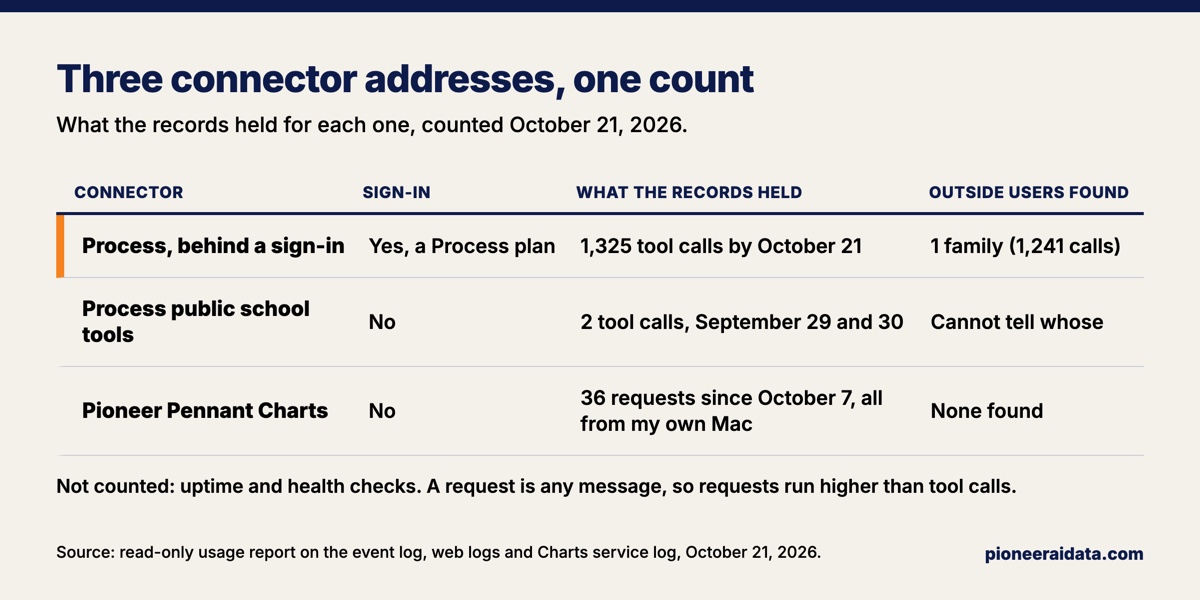
My two public connectors had no outside user I could find
The two connectors anyone can use without signing in showed no outside user in any record I have. The first is the public half of the Process connector, which answers school facts with no sign-in. The public Process tools answered 2 tool calls in their whole life through October 21, on September 29 and 30, their first two days, and the event log cannot say whose they were. The second is the Pioneer Pennant Charts connector, which serves free college softball statistics. Its web log held 36 requests from its launch on October 7 through October 21, not counting uptime and health checks, and all 36 came from my own Mac: deploy checks, test commands and the fact-checker for this blog.
A machine found the public Process address: an AI agent directory's crawler made 4 requests to it in two weeks of logs. Charts lists its connector on its own page, in a server card that describes it to software, and in the site's llms.txt. An llms.txt is a plain-language summary of a site written for AI tools, one of the pieces in what a website needs for AI assistants to read it. The page, the server card and llms.txt all answered when I checked them on October 30.
Neither connector is in an AI app's directory as of my last records, and neither is in the official MCP Registry, which held 52,988 server entries when I counted it on October 30, 2026, 52,290 of them active. A registry record holds a server's name, description, version and address, and no count of use, so the registry can say how many servers have registered and not whether anyone uses one.
The connector that got used sits inside an account the family already had
The one connector with an outside user is the one behind a sign-in the family already used, and the two public ones, which drew no outside user I could find, are listed only on my own pages and in files AI tools read, as far as I know. One family is a small sample, so this is an observation and not a law. Nothing in my records says why that family connected.
A family with an account would have nothing new to trust. A stranger connecting a public address takes it on the word of a site they just found, which is the trust problem I described when I built these connectors.
Claude does reach for a connector without being asked, once a person has connected it. Claude's help center says: "Once you've connected an app, Claude can bring it into a conversation on its own when it fits what you're asking for." Connecting is still a person's job, and none of the Claude help pages I read on October 30 describes Claude adding a connector that nobody connected.
A directory is the other way in. Anthropic's directory takes submissions from anyone on a paid Claude plan, scans each one automatically and, by default, lists it as a Community connector. Anthropic's own description says it "screens Community connectors before listing them but hasn't reviewed them in depth," so a listing is a door, not an endorsement. A listing does come with usage numbers this post had to build by hand, including the "Used a tool" count. Those numbers are in beta, leave out time windows with fewer than 5 calls, and count only Claude traffic, and Anthropic's page says: "Your own server logs can therefore show activity that this page doesn't." A connector added by hand, the way the outside family added mine, does not appear on that page at all.
One outside family is a small count, and a second family could change the share overnight. The pattern is still worth a rule: put the connector where your users already sign in, or where a directory lists it and counts for you.
How to count use of your own MCP server
Six steps cover MCP server usage for a small business, and each one comes from a number above.
- Log every tool call in your own database from the first day. Store the time, the tool's name and the account. Web server logs rotate, and mine reach back about two weeks. The Charts connector's service log reached back one day when I ran the report, and only the Process event log still held Process's launch-day calls.
- Mark your own traffic before you count anyone else's. Your tests, uptime checks, deploy checks and AI helpers are callers too. Mine were 84 of 1,325 calls on one connector and 36 of 36 requests on another.
- Report accounts that called a tool in the last 30 days, with calls beside that number. One busy account can make a connector look popular, the same way a count of runs can make an AI agent look useful, which is the gap I wrote about in measuring whether AI pays off. On my signed-in connector, one family made 94% of the calls.
- Keep registrations, connections and calls apart. Four live connections meant one outside user, and two registrations never finished.
- Leave the question out of the log unless you need it. A tool's name and an account answer whether anyone uses the connector, and no count in this post needed what anyone asked.
- Put the connector where people already have a reason to use it. That means inside an account they already have, or in a directory that lists it and counts for you.
So, is anyone using mine? One family, on 13 of 21 days, through the connector inside the account they already had. Every other person I can identify is me.
Want this run for your business?
Book a free discovery call. We map where AI fits, show you the numbers, and point you to the right plan. No pressure, no jargon.
Book a Discovery Call →