Private AI for small business means one thing: the model runs on a machine you own, and what you type into it never leaves the building. I spent two weeks running open-weight models on my own hardware to find out whether that is a real option for a small shop yet.
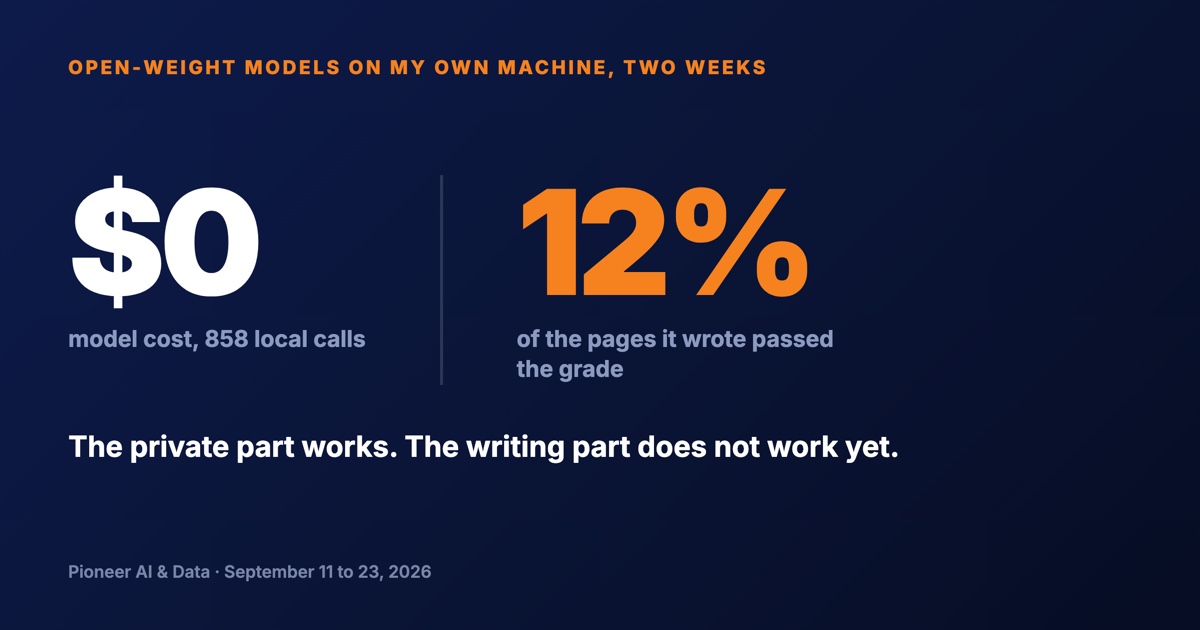
The answer has two halves and they point in opposite directions. On the data question it works completely, and running it costs close to nothing. On the quality question my own test failed, and not narrowly: of the 263 pages the local model wrote and got graded on, 33 passed. Twelve percent.
That split is the part worth your time, because it tells you which jobs in your business could move to hardware you control right now and which ones cannot. Getting AI to behave on terms you set is the AI and data work I do at Pioneer, and this is what the evidence looks like when I run the test on my own systems first.
Private AI means the model runs on a machine you own
A private AI setup replaces the vendor's server with your own. Instead of your question traveling to a company's data center and the answer traveling back, both happen on a computer sitting in your office.
Open-weight models are what make a private setup possible. "Open weights" means the company that trained the model published the finished model file for anyone to download and run. You are not renting access through an interface. You have the thing itself, on your disk, working when your internet is down. Three of them took up 35 GB on my machine, which is less space than a season of video.
The hardware is the part people assume is out of reach, and it is not. A Mac mini with the M5 Pro chip starts at $1,699 and takes up to 64GB of unified memory, which is enough to run a serious model with room left over. That is a one-time purchase in the range of a decent laptop, not a server-room project.
The thing owners are afraid of is already off by default on business terms
On a business plan, your data is already not training anybody's next model, and that is the fear driving most private AI shopping.
Anthropic's own policy page, updated August 18, 2026, says it plainly: "By default, we will not use your inputs or outputs from our commercial products (e.g. Claude for Work, Anthropic API, Claude Gov, etc.) to train our models." Consumer plans are a separate contract, and they are opt-in. The August 2025 consumer terms update let Free, Pro, and Max users choose to have their chats used for training, with retention stretching to five years if they say yes and 30 days if they say no, and it states directly that the change does not apply to commercial terms.
I lead with that because the private AI market sells hard against a risk you may have already handled, and you should know it before you spend $1,699.
The risk you have not handled is different, and it is bigger. It is the copies. Data security and privacy is now the top barrier to small businesses going deeper with AI, named by 33% of owners in 2026, up from 23% in 2025, in Bluevine's 2026 Business Owner Success Survey of 942 US small business owners fielded by Centiment in April. That worry has a specific shape in the breach data. In IBM's Cost of a Data Breach Report 2026, security incidents involving an organization's own shadow AI, meaning staff using AI tools nobody approved, more than doubled to 43% of incidents from 20% the year before. Those incidents averaged $5.39 million against a global breach average of $4.99 million. Only 40% of organizations in that study used access controls on their AI models and data at all.
Read those two numbers together and the problem is not the vendor's training policy. It is that your data ends up in five places nobody wrote down. A model on your own box fixes exactly one half of that: where the data goes. It does not fix who can see it, which is a question about permissions and written commitments, and it is the half I get asked about second in every room. That half is answered on paper, not by hardware, and how I answer it has not changed.
Two weeks of private AI cost 19 cents of electricity
The 858 calls the local models handled between September 11 and September 23 cost $0.00 in model fees and, at the very most, 19 cents in power. Those calls carried 3,615,035 tokens of input and returned 367,885 tokens of output.
Not "cheaper." Zero. There is no meter. Once the model file is on your disk, the only thing a call consumes is electricity. All 858 calls add up to 9 hours and 34 minutes of the machine actually working. Even if the laptop had drawn the full 140 watts its power adapter is rated for for every one of those minutes, that is 1.34 kilowatt-hours. At Ohio's average commercial rate of 14.06 cents per kilowatt-hour in July 2026, the whole two weeks comes to 19 cents.
Compare that to the bill the local setup was being tested against. The job I was trying to move ran twice a day on a frontier model, meaning one of the largest commercial models on the market, and 53 runs of it cost $61.78: an average of $1.17 each and $2.39 on the worst day. That is a real line item you can point at, and it is the kind of number I work through in more detail in what AI actually costs a small business.
So the cost case is genuine, and it is the reason every page selling private AI leads with it. Here is the part those pages leave out.
The job I tried to move passed 12% of its graded pages
381 pages went through the local model. 263 of them came back with something worth grading, and 33 of those passed, which is 12%. 230 failed outright, 116 produced nothing gradeable at all, and 2 errored.
The test was not a demo. I took a real job that had been running twice a day for a month, replayed 53 of its finished runs through the local model with the same source material and the same instructions, and had every page graded against a fixed rubric. A page passes only if it invents nothing and scores at least 4 out of 5 on keeping the facts, coverage, prose, and house style. Two of the eight desks in that job never passed once in 49 attempts each.
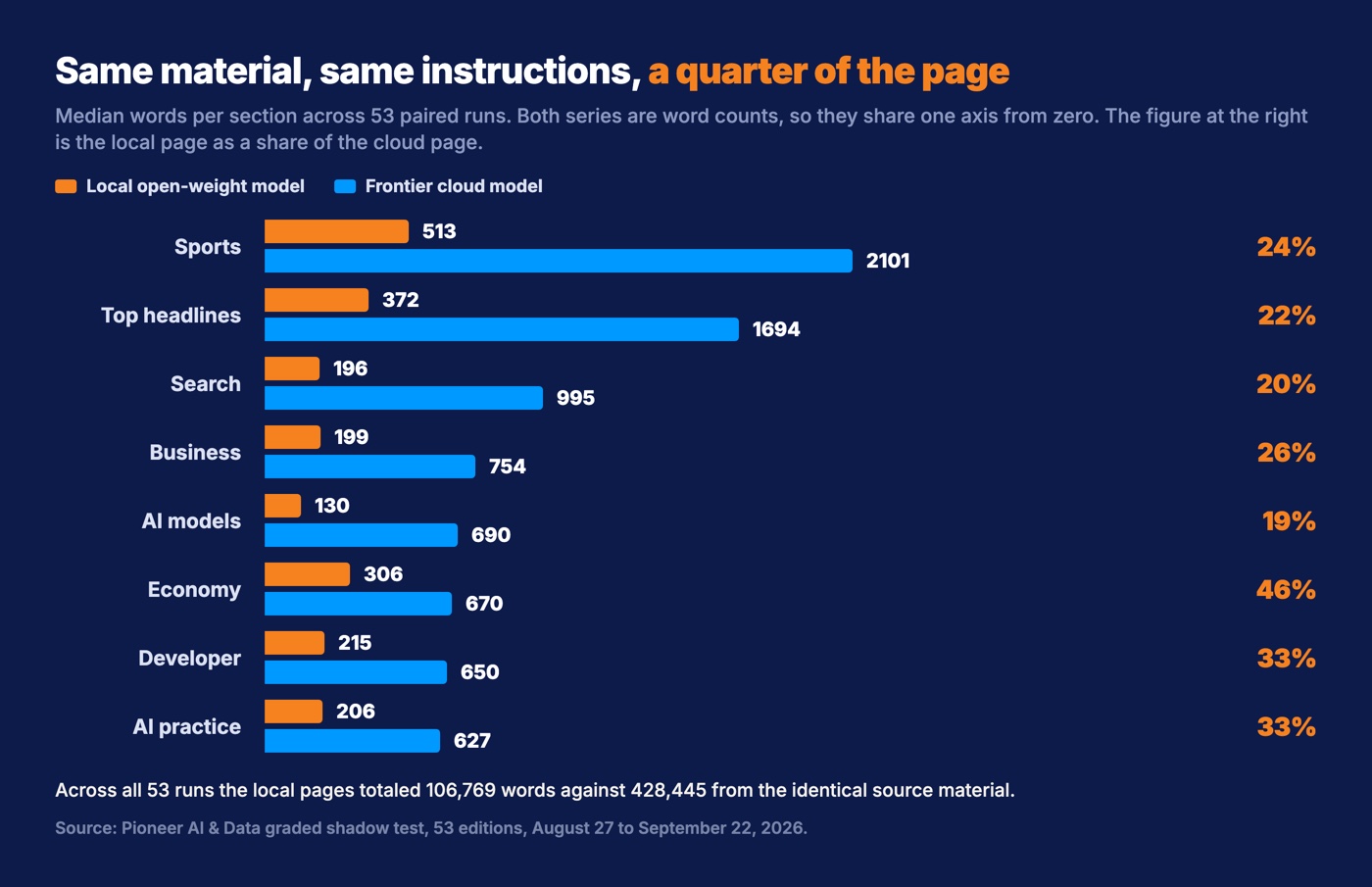
The most common reason was not that the model got things wrong. It was that the model said a quarter of what the job needed it to say. Coverage scored below 4 out of 5 on 202 of the 381 pages, and the length data shows why: across those 53 paired runs, the local pages totaled 106,769 words against the cloud model's 428,445 from identical source material. Same input, same instructions, and the local model handed back 25% of the page. The worst desk came back at 19% of the length, the best at 46%.
The second reason was worse. 136 of the 381 pages carried at least one link that did not exist in the source material, 431 invented links in total, usually a mangled version of a real address or a plausible-looking one the model assembled itself. The grader treats an invented link as fabrication and fails the page on the spot, which is the right rule. A page with a link in it that goes nowhere real is not a thin page, it is a wrong one.
One thing the local model did nearly perfectly: across all 381 pages it produced 13 em dashes, in 7 pages. Told not to use a character, it almost never used one. The narrow instruction held. The broad one did not.
I run the same kind of scoring on my own forecasting work, and published five months of those grades when the simple baseline beat the fancy model. Grading your own AI is the only way to know, and it is uncomfortable on purpose.
Most of the failures were not the machine, they were the format
Of the 858 local calls, 323 came back with nothing a script could use, and 313 of those 323 were the model failing to return the format the job asked for. That is the finding I have not seen anywhere in the private AI conversation, and it is the one that would have cost me the most if I had skipped the test.
203 of those were the model writing the answer correctly and then carrying on talking past it, which breaks the code reading it. In another 100 there was no structured answer anywhere in the reply. The last 10 came back malformed.
Only 10 of the 323 failures were the machine or the service: 7 refused connections, 1 dropped mid-answer, 1 deliberate bad-model test, 1 unsupported option.
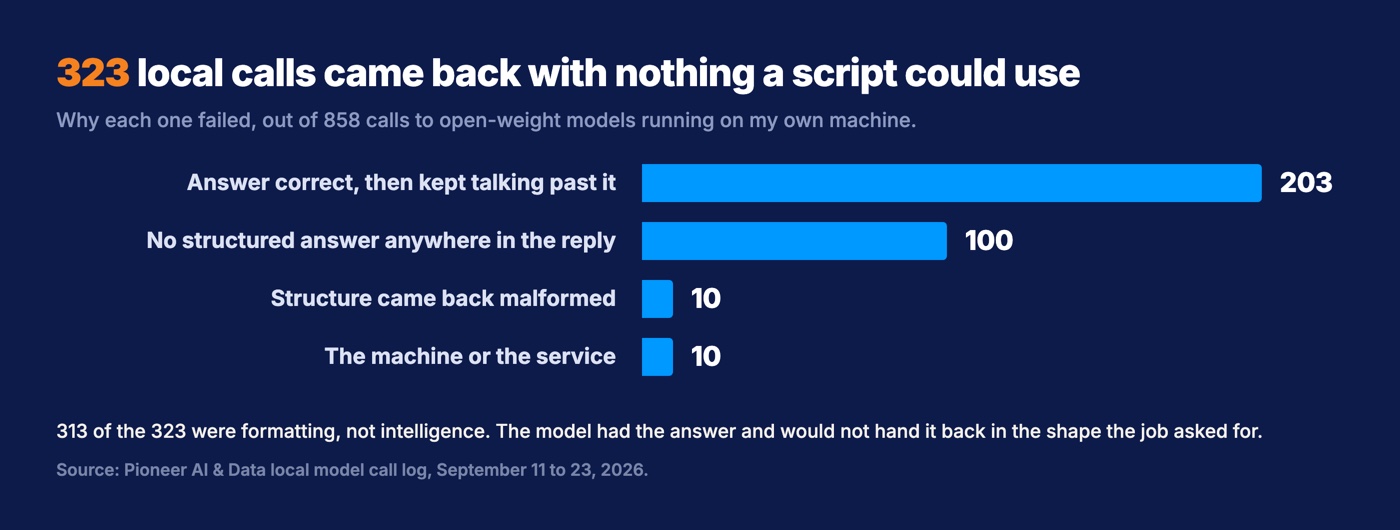
The hardware was not the problem, and the model was not even wrong most of the time. It just would not answer in the shape the surrounding software needed, roughly one call in three. If you are picturing private AI as a chat window, that failure mode does not exist for you, because a human reads the answer and shrugs off the extra sentence. If you are picturing it doing a job, which is the only reason a business buys it, every one of those 323 calls is a step in a process that stopped.
A frontier model gets the format right far more often, partly because it is bigger and partly because the paths into it enforce the shape. There are fixes on the local side, and I know what they are now: ask for smaller answers, have the code fill in anything the model should not be inventing, and constrain the output so an off-format answer is impossible rather than merely discouraged. None of the three was in place when I ran this test, which is the reason the test was worth running.
The jobs that worked all have the same shape
Every job the local model finished cleanly was asked to decide something small, not to produce something a person would read. Not everything failed. The jobs that worked, worked completely.
Categorizing bank transactions: 6 of 6, about two seconds each, with only one worth arguing about. Writing a handful of bullets off a table of numbers it was not allowed to leave: 1 of 1. Turning my own notes into searchable numbers, which is the least glamorous AI job there is: 15 nightly runs, zero failures, zero lines of error output, 1,199 files and 11,608 chunks indexed, and a median run of 12 seconds. That job has never once needed me.
Reading a photo of a fridge shelf and listing the food took three tries to get a usable answer, then worked in under eight seconds. Grading pages, which I also asked a local model to do, came back usable 53% of the time, worse than the writing it was supposed to be judging.
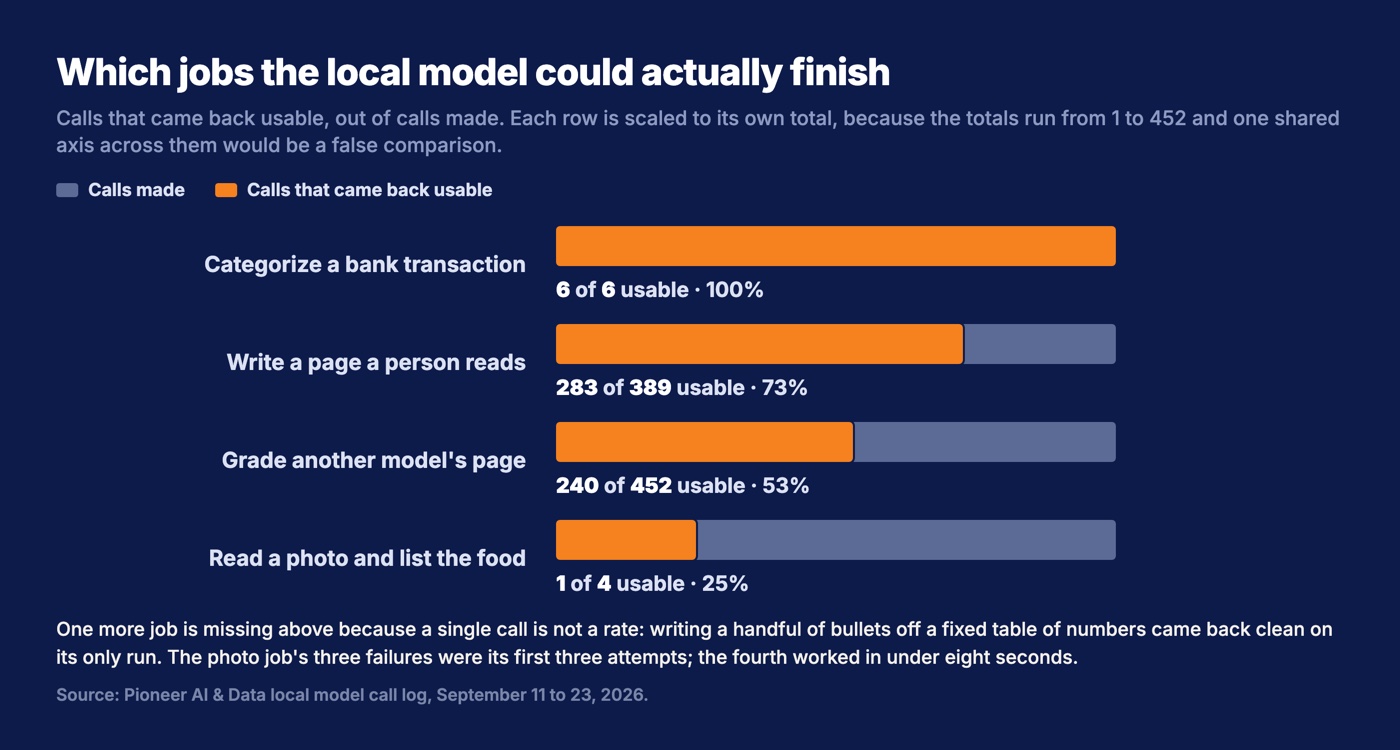
The pattern is not about difficulty. It is about output size and who consumes it. Sort this, label that, score this, find the closest match: those finished. Write the page my customers will read: that failed seven times out of eight.
A 3.3% benchmark gap does not predict your gap
The published gap between open and closed models is genuinely small, and it did not predict my result at all. As of March 2026, the best closed model led the best open model by 3.3% on head-to-head comparison, up from 0.5% in August 2024, according to Stanford HAI's 2026 AI Index. Six of the top ten models on that leaderboard are closed.
Three percent sounds like nothing. My gap was not three percent. It was a 12% pass rate against a job that had shipped every single day without complaint, and a page one quarter as long.
Both numbers are true, and they are measuring different things. A benchmark asks whether a model can answer hard questions about the world. Your business asks whether a model can do one specific job, in one specific format, on your material, without supervision, every day. The first is a general capability. The second is a fit, and nobody has measured the fit for your job except you.
The only honest way to decide is to measure the fit yourself, and that is not a hard project. Take a job the AI already does, run the last month of it through the local model with the same instructions, and score the output against what actually shipped. If it passes, move it and keep the cloud version as a fallback. If it fails, you learned that for the price of a weekend instead of the price of a quarter.
How to tell which of your jobs can move to your own hardware
Ask what the AI hands back and who reads it next. That one question sorts the jobs, and it needs no token math and no break-even chart.
If the answer is a decision, a label, a score, a category, or a match, and the thing that reads it next is your software, a local model can probably do it today. Those jobs are narrow, their answers are short, and a wrong one is cheap to catch because the check is mechanical. They are also, conveniently, the jobs most likely to be touching the data you least want leaving the building: transactions, records, documents, photos of your own premises.
If the answer is something a customer, a prospect, or your own staff will read and act on, keep it on a frontier model until you have graded a local one and it passed. Nobody will ever see the label your system put on a transaction. Everybody sees the email.
| What the AI hands back | Who reads it next | Where it can run today |
|---|---|---|
| A category, score, label, or match | Your software | Your own hardware |
| A search result over your own records | Your software, then you | Your own hardware |
| A short summary bounded by numbers you supply | You | Your own hardware, with a check |
| A page, email, or reply | A customer or your staff | Cloud, until a local one passes a real grade |
Two rules sit on top of that. No job moves without a graded side-by-side against what it replaces, because "it looked fine when I tried it" is not a measurement. And every local path keeps a cloud fallback, because a model on your desk is a machine in your building, and machines in buildings go down.
I killed the job instead of moving it
On September 23 I retired the job this whole test was built around, not because the local model failed but because the job itself was not worth what it cost me in money or attention. That is the part of the story that would be easiest to leave out.
So the savings never happened. The $61.78 line item the local build was going to eliminate is gone because I stopped running it, and the two weeks of grading ended in a decision not to do the thing at all. That is a real outcome of measuring something, and a more common one than the case studies admit.
What I actually got was worth more than the savings. I now know, from my own logs rather than somebody's benchmark, that private AI on hardware a small business can afford is ready for the narrow work and not ready to write. I know the failure that will bite first is formatting, not intelligence. And I know what I would have to fix before I put a local model in front of a client's data, which is the only reason I ran it on my own data first.
Two weeks and 858 calls is a small test, and the honest limit on all of it is that a better build would score better. The models I used will be replaced, probably before the end of the year, and the 12% will move. But the shape of the finding will hold longer than the number: the jobs where nobody reads the output directly are the ones that can come in-house first, and they happen to be the jobs sitting closest to the data you actually worry about.
If you want the version of that answer that fits your shop, the place to start is a list of the AI jobs you are already running and what each one hands back. That list takes an hour and decides the rest.
Want this run for your business?
Book a free discovery call. We map where AI fits, show you the numbers, and point you to the right plan. No pressure, no jargon.
Book a Discovery Call →