Your AI gives generic answers because it has never seen your business. It answers from the public internet, which means it averages every company that looks vaguely like yours and hands you the middle. That is not a prompt problem and it is not a model problem. It is a missing information problem, and the fix is to give the model your business in a form it reads every time, instead of the one chat window where you happened to paste it.
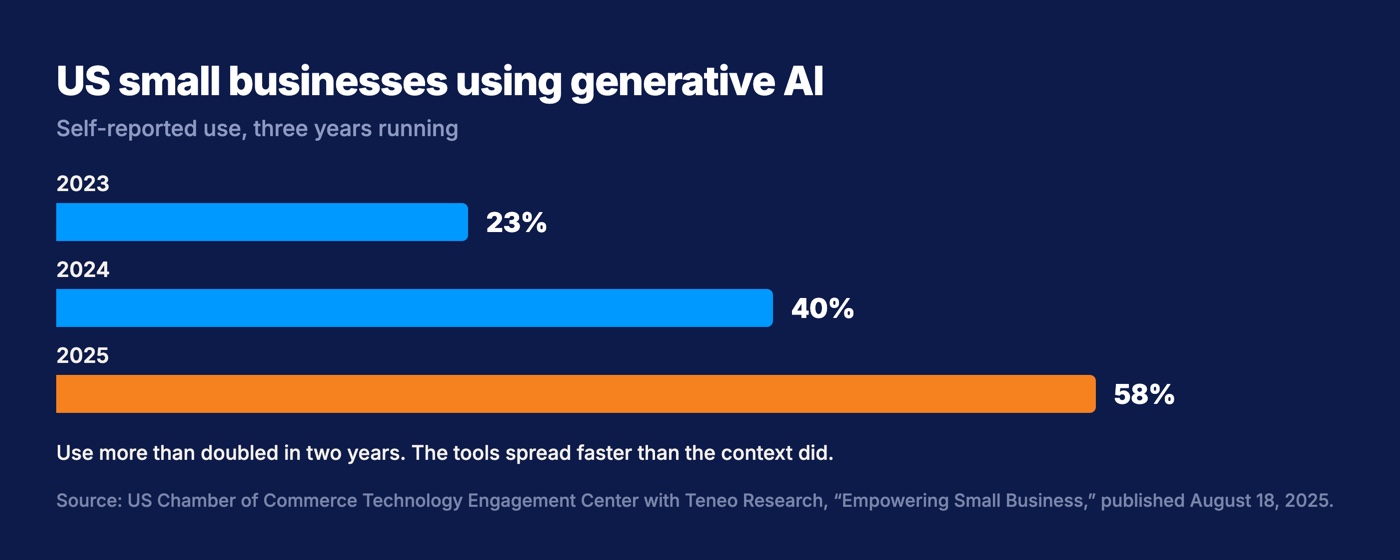
Almost every small business is running into the generic-answer problem now. 58% of small businesses used generative AI in 2025, up from 40% in 2024 and 23% in 2023, according to the US Chamber of Commerce Technology Engagement Center's report with Teneo Research. Stanford's 2026 AI Index puts organizational adoption at 88% for at least one business function. The tools are everywhere. The context is not. Closing that gap is the first thing we build in any AI engagement, and we run the same system on our own company, so most of the numbers below are ours.
What your AI is actually doing when it gives you a generic answer
Your AI is producing the most statistically likely response to your question, drawn from what it read during training. Your pricing is not in there. Neither is the way you quote a job, the three questions every customer asks before they book, or the reason you stopped taking a certain kind of work in 2023. The model fills those gaps with the average of everyone else, which reads as bland because it is bland. You are getting the middle of a very large pile.
That averaging is why the advice comes back sounding like a business school handout. The model isn't being lazy. It is doing exactly what it was built to do with the information it has, and you haven't given it any.
A better prompt is a workaround, not a fix
Prompting works, and it stops working the moment you close the tab. Type three paragraphs about your business into the chat and yes, the next answer gets sharper. Then the session ends and you type it again tomorrow. Your office manager opens her own chat and describes the business differently than you did, because she remembers it differently. A month later you try a second tool and start from nothing.
The newest assistants do remember things now, and that changes less than it sounds. Look at how the remembering is built. Anthropic's documentation for its memory tool describes a directory of files: the model "stores what it learns in files" and "reads them back in later conversations," and those files sit in storage the customer controls rather than inside the model. The vendors solved this for themselves by giving the model a small folder of documents to read before it answers. That is the same move this post is arguing for, at a much smaller scale, built out of whatever came up in past sessions instead of out of how your business actually runs.
Nearly every article on this subject tells you to write a better prompt. That advice isn't wrong, it's just small. It treats a permanent gap as a typing problem and hands the work to the person who is already the busiest. The real question is not how to describe your business well once. It is how to stop having to.
Giving the AI your business means building it a knowledge base
A knowledge base is your business written down in one organized place that the AI reads before it answers. It is not a reinvention of your company, just the one you already run: how you price, who you serve, what you turn down, how you talk, what happened last quarter and why.
Ours is 246 notes and about 321,000 words, measured this month. It covers six departments, and sales and marketing is the largest section by a wide margin, because that is where the most decisions get made and the most language gets reused.
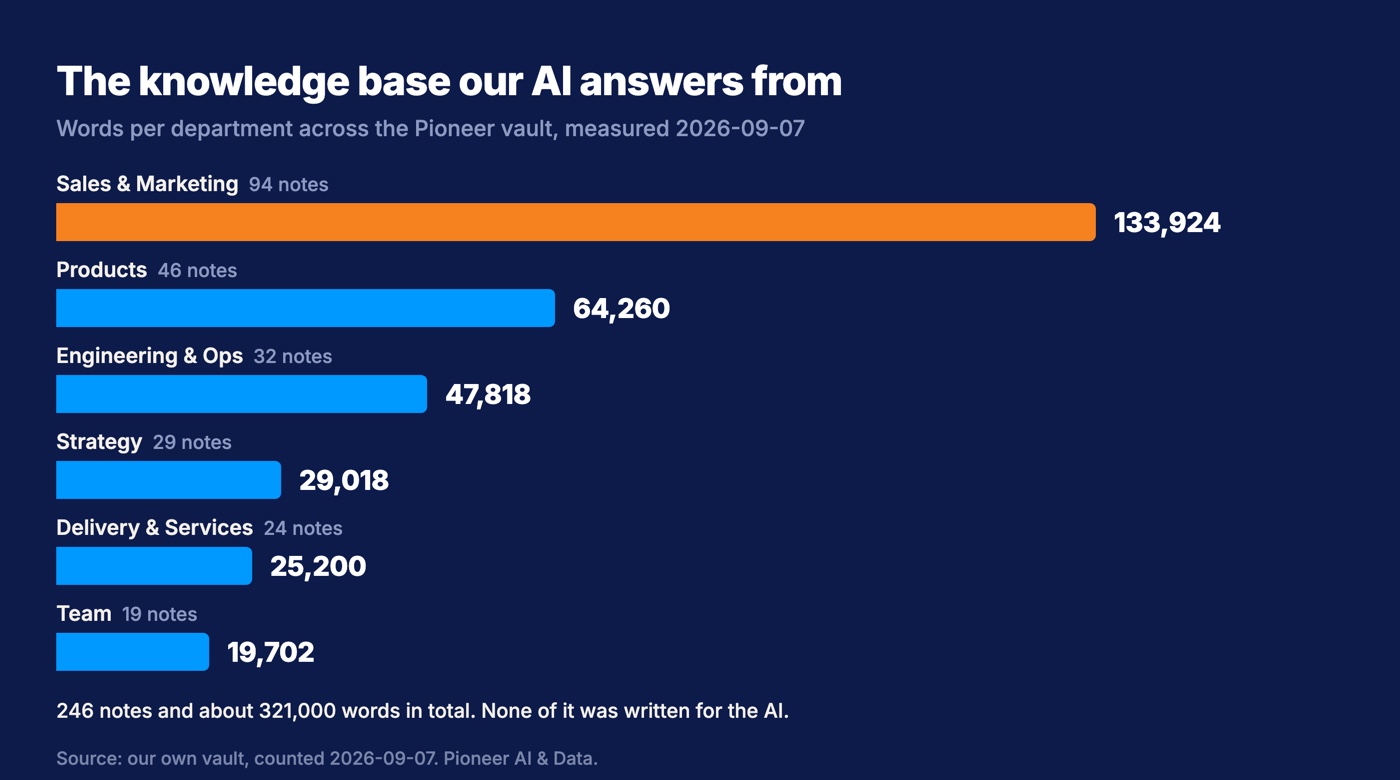
None of those notes were written for the AI. They were written because we needed them anyway. The voice profile our tools write against came out of nearly 623,000 of my own outgoing messages, which existed years before there was anything to point at them. That is the part owners keep missing: you already own the raw material. It sits in your quotes, your email replies, your job notes, your website, and your head. It has just never been organized into something a machine can read.
Pointing a model at that material has a name and six years of research behind it. Retrieval-augmented generation means the AI looks something up in your documents before it answers, instead of answering from memory. The 2020 paper that introduced the technique found that models given retrieved documents "generate more specific, diverse and factual language" than a comparable model working from memory alone. Specific is the opposite of generic, and that specificity comes from the documents, not from the prompt.
Dumping every file into the chat window does not work either
More text is not the same as better context. Past a point, extra text makes the answers worse. A Stanford-led team tested how language models use long inputs and found performance "degrades significantly when models must access relevant information in the middle of long contexts, even for explicitly long-context models." Their paper is called "Lost in the Middle", which is a fair description of what happens when you paste your entire operations folder into a chat and ask a question.
Bigger context windows did not fix that. The 2025 NoLiMa benchmark tested 13 models that all advertise at least 128,000 tokens of context, and at 32,000 tokens 11 of them scored below half their own short-context baseline. GPT-4o held up better than most and still fell from 99.3% to 69.7% on that test. A controlled study published in March 2026 padded the same questions with irrelevant text and watched accuracy slide again, and questions that require connecting two facts degraded about twice as fast as questions whose answer sits in one place. Anthropic's engineering guidance now calls context "a finite resource with diminishing marginal returns" and names the effect context rot: as the number of tokens in the window goes up, the model's ability to recall what is in them goes down.
The fix is structure, and structure is boring on purpose. In our vault every folder has one note named after the folder, and that note is the index: it says what lives there and links to the pieces each task needs. The AI knows the rule, so it always knows where to look. It reads the index, opens the two documents the index points to, and comes back with an answer built from those instead of skimming four hundred files. That is the pattern the model makers now recommend to their own developers: hold lightweight references such as file paths, and pull a document into context at the moment it is needed.
AI is a program. Programs run better on consistent structure than on volume. That one naming rule does more for answer quality than any prompt I have ever written.
Grounding AI in your content is not the same as trusting it
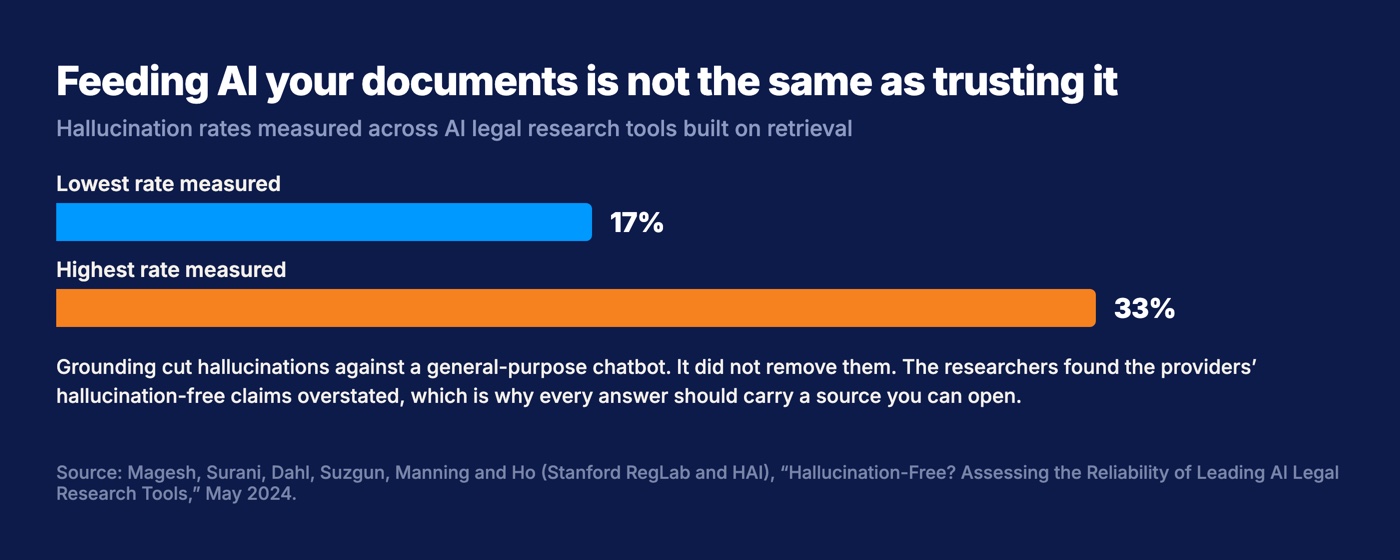
Feeding a model your documents reduces invented answers. It does not eliminate them, and anyone who tells you otherwise is selling. Stanford researchers tested AI legal research tools built on exactly this approach and found they hallucinated between 17% and 33% of the time, against vendor marketing that promised hallucination-free results. To hallucinate here means the tool gave an answer that sounded right and was wrong. The researchers concluded the providers' claims were overstated, even though the tools did beat a general-purpose chatbot.
That study ran in 2024 and the models have improved since. The failure mode has not gone away. A July 2026 evaluation put two current frontier reasoning models through retrieval-grounded question answering and found they scored higher than a corrective pipeline on how relevant their answers were, and lower on whether those answers actually came from the documents they cited. The authors put it plainly: the frontier models "output highly relevant answers without extracting their claims from the cited documents." What beat them was not a better model. It was a pipeline that filtered the documents before the model wrote and checked every claim against the cited text after it wrote.
So we hold every assistant we build on a client's own content to one written standard: cite the source or say you don't know. The answer names a document the reader can actually open, one source per claim, in the answer itself. An answer that comes back with no source is never shown, because the system replaces it with the refusal instead. That rule lives in the code rather than the prompt, since the prompt is the part that drifts.
The refusal is the useful part, which is backwards from what most people expect. When the assistant says "I don't have that in your materials, so I don't want to guess," nothing has failed. A cluster of refusals on the same subject means a missing document, not a broken bot. It tells you exactly which part of your business you never wrote down.
Missing context is where most of the AI money quietly goes
Most AI projects fail on context, not on technology. MIT's NANDA initiative reviewed 300 public deployments, interviewed 150 leaders, and surveyed 350 employees for its 2025 report. About 5% of AI pilots achieve rapid revenue acceleration, and "the vast majority stall, delivering little to no measurable impact on P&L." The report did not blame model quality. It named a learning gap instead, noting that general-purpose tools "stall in enterprise use since they don't learn from or adapt to workflows."
MIT was measuring enterprise budgets. Small businesses fail the same way for less money. The typical small business now runs five different AI tools and spends a median of $2,200 a year on them, according to the SBE Council's February 2026 survey of 517 employers. Five tools, none of which knows what you do, each one waiting for you to explain it again. We published the full breakdown of where that money goes in what AI actually costs a small business earlier this month.
How to start this week, without buying anything
Start by writing down the answers you are tired of giving. Not a documentation project, just the things you repeat.
- List the ten questions you answer over and over. Customers, staff, and new hires. Those ten answers are the highest-value content in your business and most of them have never been typed anywhere.
- Write each answer once, in one file, in plain language. Include the numbers. A price range, a lead time, a warranty term. Vague answers make vague AI.
- Name the files what they are and put them in one folder. "Pricing," "Scheduling," "Warranty." Clever names help nobody.
- Give each file an owner and a review date. Content nobody is responsible for goes stale, and stale content produces wrong answers with confident citations attached, which is worse than having no assistant at all.
- Point your AI at that folder and ask it the same ten questions. The difference in the answers is the whole argument, and you can see it in an afternoon.
That is the sequence we run before anything gets built, and the longer version is written out in the playbook. The tools are the commodity here. Getting what you know out of your head and into a shape a machine can read is the actual job. The chatbot, the email drafts, the quote assistant, all of it is only as good as that folder.
The rule we hold ourselves to is simple enough to steal. The content has to exist and be structured before you point an AI at it. No model, no vendor, and no clever prompt fixes the fact that the procedure still lives in somebody's head.
Want this run for your business?
Book a free discovery call. We map where AI fits, show you the numbers, and point you to the right plan. No pressure, no jargon.
Book a Discovery Call →