Search for AI maintenance cost and you get a page of the same answer: budget 15 to 25% of your build cost every year, or somewhere between $5,000 and $50,000 annually. Those numbers come from firms quoting enterprise builds, and they are aimed at the companies most likely to buy one. The US Census Bureau's Business Trends and Outlook Survey found 37% of firms with at least 250 employees using AI in their operations, against less than 20% of firms with four or fewer employees. If you are in the second group, a percentage of a $100,000 project tells you nothing, because you were never going to spend $100,000.
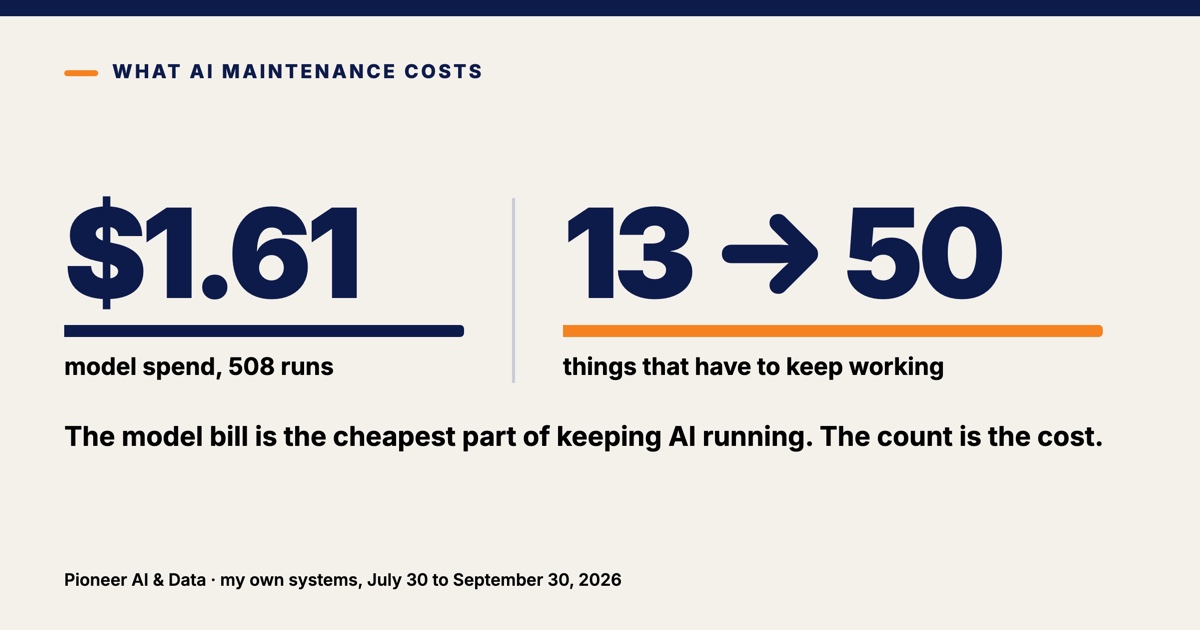
So here are my own receipts instead. I run a set of AI systems for my own business and my own house, and I read the meters this morning. Two months of model spend across two scheduled agents came to $1.61 over 508 runs. In the same two months, the number of things I have to keep working went from 13 to 50.
The dollar figure is the part everybody asks about and the part that matters least. Making AI behave after you build it is my job at Pioneer AI & Data, and the honest version of the upkeep question is not a price. It is a count.
The model bill was $1.61 for two months
Two of my scheduled agents spent $1.6080 in model fees across 508 runs between July 30 and September 30, 2026. Both of them meter themselves, so every run writes down what it cost. One triages the business inbox four times a day. One does the same for the family inbox five times a day.
| Business inbox | Family inbox | |
|---|---|---|
| Runs | 253 | 255 |
| Successful | 251 | 255 |
| Period | Jul 30 to Sep 29, 2026 | Aug 11 to Sep 30, 2026 |
| Model spend | $1.1529 | $0.4551 |
The most expensive single run in the whole set was eight cents. The average was less than half a cent. And 90 of the 253 business runs cost exactly nothing, because a run with no new mail still runs.
Two honest limits on those numbers. Six of the 253 business runs recorded no cost at all, so the real figure is a hair higher than $1.61. And a third agent, the one that reads research, adds $0.13, but it only wrote down a cost on 4 of its 22 runs, so I keep it out of the headline rather than pretend the total is complete. A meter with holes in it is the most common thing I find when I open up somebody else's AI setup, including my own.
The other half of this question, what it costs to get something built in the first place, I wrote down separately.
The real number is how many things have to keep working
Between July 30 and September 29, 2026, the count of systems I have to keep alive went from 13 to 50. Every scheduled job I run is listed in one registry, so I can count them on any date by reading that file's history. Here is what the count did over the same two months as the model bill above.
| Date | Scheduled agents | Plus always-on services | Total |
|---|---|---|---|
| Jul 30, 2026 | 10 | 3 | 13 |
| Sep 3, 2026 | 20 | 13 | 33 |
| Sep 9, 2026 | 25 | 13 | 38 |
| Sep 23, 2026 | 29 | 17 | 46 |
| Sep 29, 2026 | 33 | 17 | 50 |
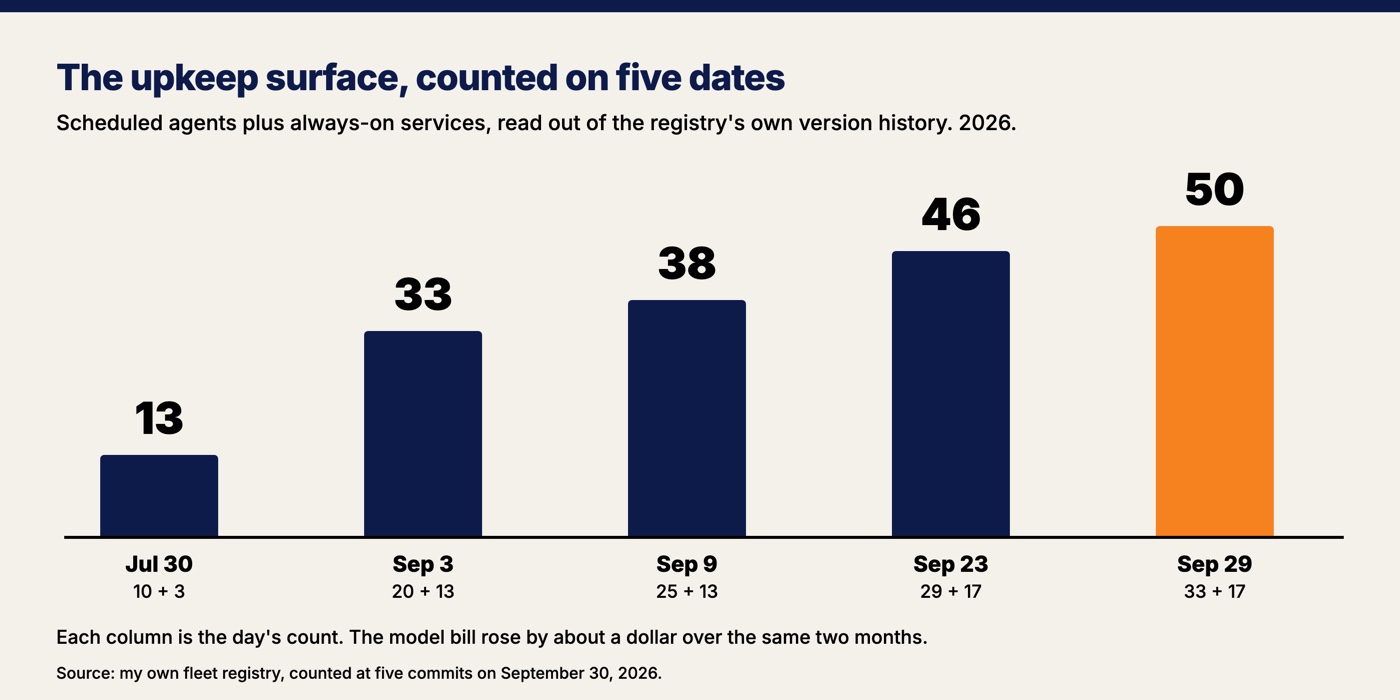
The model spend went up by about a dollar over those two months and the surface I am responsible for nearly quadrupled.
AI upkeep at small scale is a count of moving parts, not a percentage of a build. Each new agent costs pennies to run and adds one more thing that can quietly stop. Nobody sends an invoice for that. You pay it in attention, which is the one budget line a small business owner cannot expand.
The academic version has been on the record since 2015, when a team of Google researchers published Hidden Technical Debt in Machine Learning Systems and wrote that "it is common to incur massive ongoing maintenance costs in real-world ML systems." They were describing systems far larger than mine. The finding travels down, and a decade of newer models has not made it go away.
Nothing that broke in two months was the AI
Two of those 508 runs failed. Both failures were the same thing: a missing environment variable, which is the setting that hands a program its password for an outside service. The agent could not find its key, so it stopped. August 28 and August 29.
Zero runs failed because of the model. No refusals, no garbled output, no rate limit, nothing about quality. The model was the most reliable component in the system.
Four other things broke in the last two weeks. None of them was a model either.
A Facebook page token died on September 23 or 24, and nothing told me until the 29th. Five or six days, depending on which night it went. That token was created from a personal login, and a page token made that way reads "never expires" right up until a password change or a security reset on the account kills it. Mine died. Four blog promotion cards never posted while I had no idea anything was wrong.
The worse half of that story is the reporting. The job that was failing reported success. It exited cleanly, so its status card read OK, and it wrote "scheduled to Facebook" into three consecutive days of my own notes. All three were wrong. I corrected them on the 29th. A job that lies politely is the expensive kind of failure, and I have written before about how quietly websites and scheduled jobs break.
A real inbound lead was lost on September 16 at 8:04 in the morning. Somebody on an older browser filled out my form, got a save error, and left. Nothing saved, so I have no idea who it was. The cause turned out to be three duplicated field names that only JavaScript hides, so a browser that did not run the script sent both copies of each and the database refused the whole row. Nothing about that is an AI problem, and it cost me the only thing on this list a customer would notice.
A payment webhook rejected nine deliveries in a row. A webhook is the message one service sends another when something happens, and a signature is how the receiver knows the message is real. Mine was refusing real messages, because one of the two secrets had stopped matching the other. Two genuine events on September 18 and 20, plus the automatic retries, all bounced.
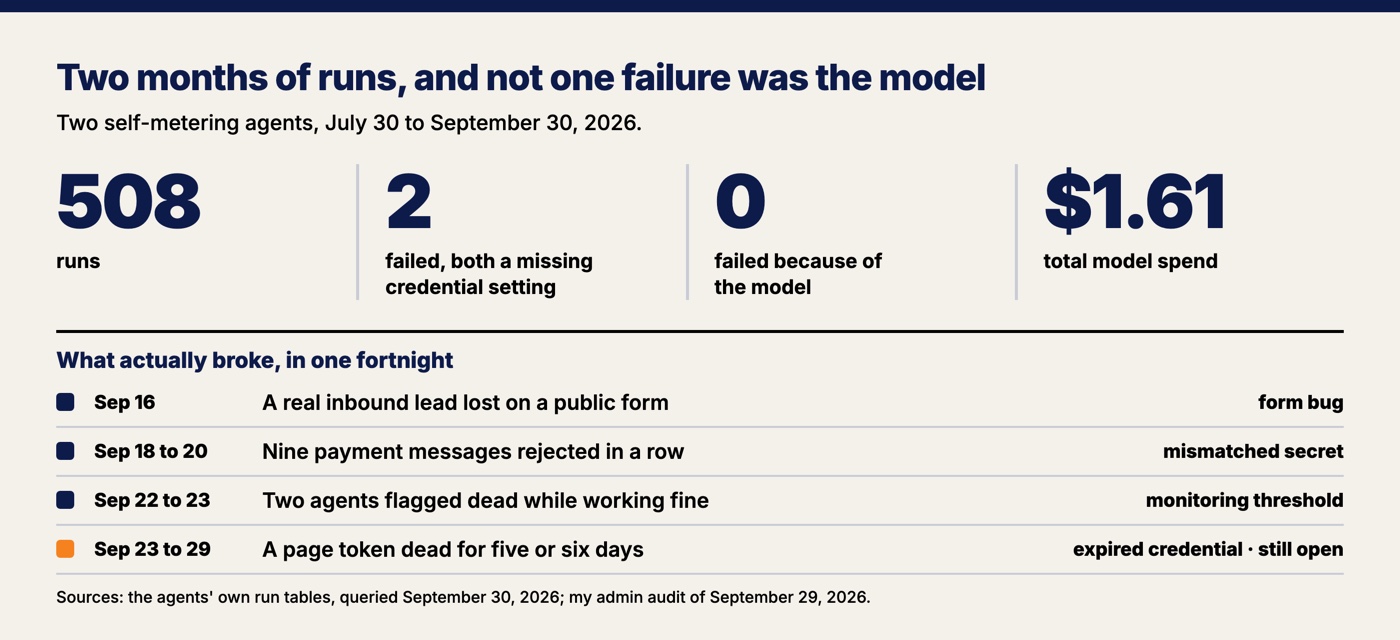
One credential, one monitoring blind spot, one form bug, one mismatched secret. Not one of the four would have been caught by a better prompt or a newer model.
Monitoring is a thing you maintain too
The dashboard that watches all of this is itself one of the 50 things.
On September 22 and 23 two agent cards read STALE every night. Every run of both agents had succeeded. The staleness thresholds had been set below the agents' own overnight pause, so a normal quiet night looked like a dead job. I raised the thresholds and the cards went green.
That is upkeep with no incident behind it. Nothing was broken. The thing watching for broken was wrong, which costs the same morning either way.
Monitoring gets the other direction wrong too, and that direction is worth more. The very first time that dashboard collected data, back on July 30, it found a health check that had failed 41 of its 2,613 runs over the previous two weeks and a nightly backup that had missed one night in ten. Both had been running that way in the dark. Counting them was the whole fix.
Your models get retired on someone else's calendar
Here is the upkeep line nobody puts in a budget: the model your system calls has an expiration date, and it is not your date.
Anthropic publishes the schedule on its model deprecations page. The commitment is "at least 60 days' notice before model retirement for publicly released models," and once a model is retired, "requests to retired models will fail." During 2026 alone, seven Claude models reached their retirement date on five separate dates: January 5, February 19 (two models), April 20, June 15 (two models), and August 5.
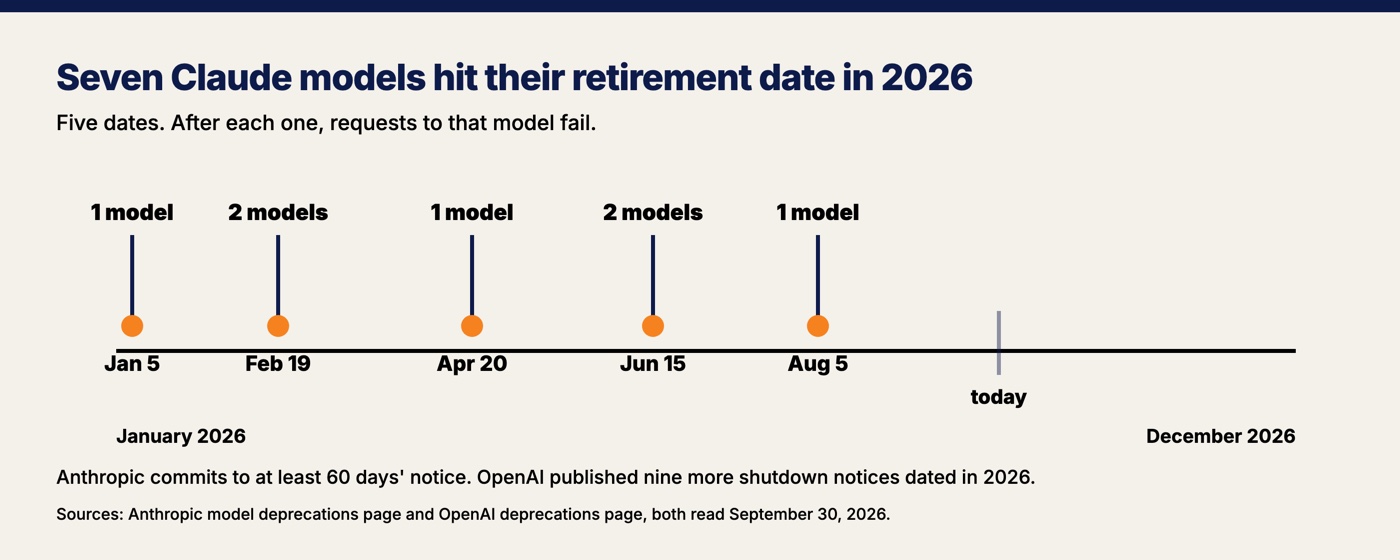
OpenAI publishes the same kind of page. Nine model or endpoint shutdown notices are dated in 2026, with shutdown dates running from October 1, 2026 into February 2027, and the policy is at least six months of notice for generally available models, at least three for specialized ones, and as little as two weeks for previews.
It is not only the models. Request settings retire as well. Three common parameters are now deprecated on newer Claude models and return an error when set to anything but their default, and the current Python library removes them entirely, so code that passes one raises an exception instead of being politely ignored. I hit that one myself and wrote it down in my own notes before I understood why.
The obvious question is whether a newer generation of models makes any of this go away. It does the opposite. Every new generation is the reason an older one gets a retirement date, so the faster the models improve, the more often somebody has to go change a line of code. Published dates and 60 days of email are about as good as a dependency gets, and I am not complaining about them. The point is that your AI system has a component somebody else controls, on a clock you have to read. Twice a year is not a burden. Zero times a year is how a working system stops working on a Tuesday.
You pay upkeep on everything you built, not on what you use
Ten of the 17 pages on my own internal admin site got two visits or fewer over two weeks, and all 17 still had to keep working. That is the cost line I found most uncomfortable. Two weeks of the access log, September 15 through 29, 2026, counted 161 page loads across those 17 pages.
| Page | Loads in 14 days |
|---|---|
| Draft review desk | 97 |
| Client dashboard | 17 |
| Agent manager | 13 |
| Pennant admin | 8 |
| Three more pages | 3 to 5 each |
| The other ten pages | 1 or 2 each |
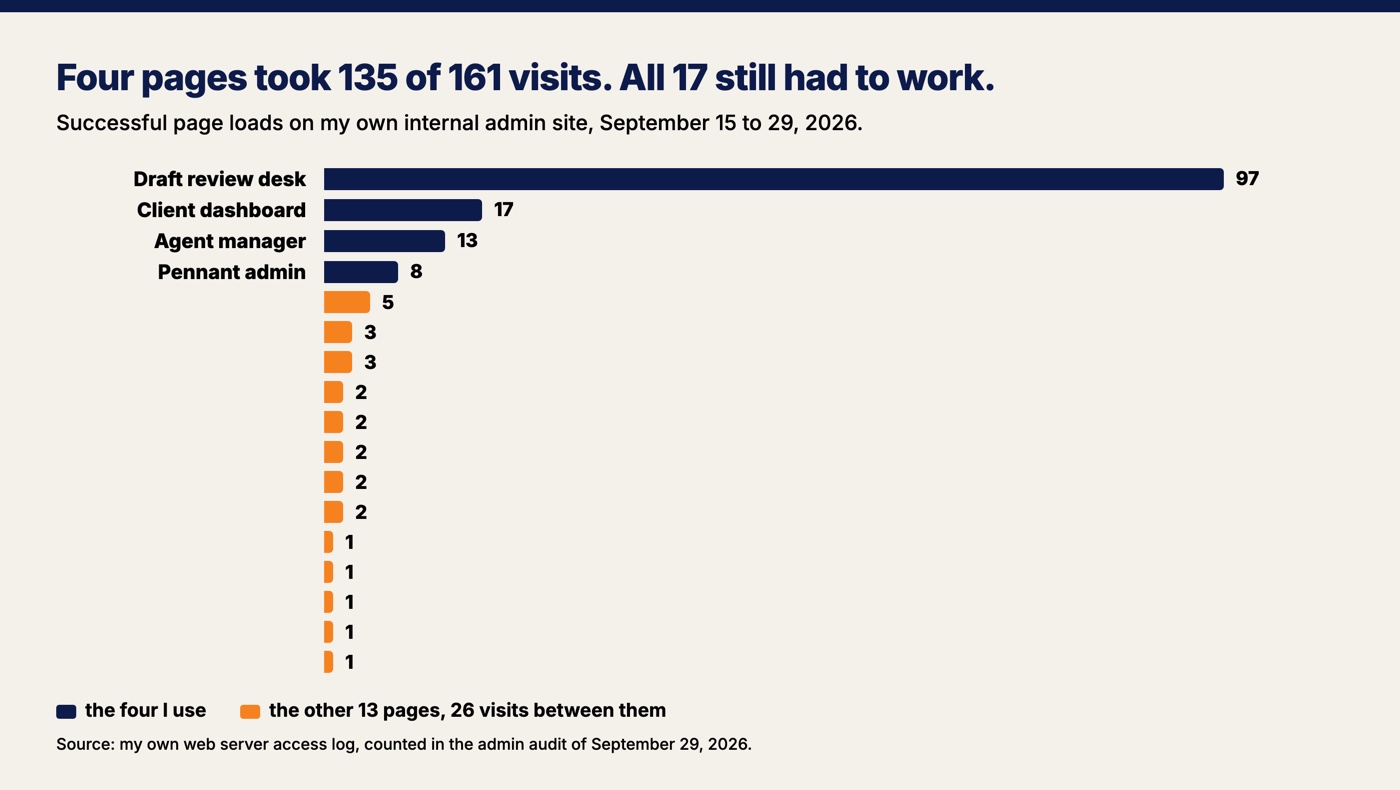
Four pages took 135 of the 161 loads. Behind all 17 sat about 12,000 lines of code, and all of it still broke when something upstream changed, and still showed up in my morning as something to fix.
Surface area is the line nobody quotes. Not the model bill and not the hosting, the sheer number of things you agreed to own. Every screen you build is a screen you maintain forever, whether you open it or not. It is also the cheapest item on this whole list to fix, because the fix is deleting pages.
What a small business should budget for AI maintenance
Skip the percentage-of-build math. It was written for companies with an IT department. Budget these four lines instead.
The model bill, which will surprise you by being small. Mine is under a dollar a month per agent at real volume. Measure it per run and multiply, and do not let anyone quote you a monthly AI cost without showing you a per-run number.
One or two hours a month per system, for the plumbing. Credentials expire, secrets drift apart, a platform changes a rule, a browser does something your form did not expect. This is where the money actually goes, and none of it is AI work. It is the same maintenance any software has, which is why the AI part of an AI project is rarely the part that costs you.
A recurring calendar item to read your vendors' deprecation pages. Twice a year, fifteen minutes. Cheapest line on the list, and the one most likely to get skipped right up until it is the reason nothing works.
A hard count of how many things you own. If it is 50, you cannot hold them in your head, which means every one of them needs to report after every run or you are guessing. That was the rule I wrote for myself in September, and the four failures above are what happens in the gaps where it is not enforced yet.
That last line is also why I sell a month rather than a project. Upkeep does not end, so the arrangement should not pretend it does. Bringing me on runs $3,500 a month for about half a day a week or $7,000 a month for about a day a week, flat, with no long-term contract and 30 days' notice on either side. The pricing page has the rest of it.
What this does not prove
Two months is two months. My systems are small, and a business with real transaction volume, regulated data, or a model it trained itself has upkeep I have not paid for and should not pretend to price.
The $1.61 is also not the whole cost of running these agents, only the model spend. It leaves out the hosting, the machine on my desk, and my own hours. I have not tracked my hours on these systems well enough to publish a number, and I am not going to invent one for a blog post.
And one of the four failures above is still not fixed. The dead token needs a credential minted from a business account rather than a personal login, which is a job I have not done yet as I write this. I could have waited a week and published a cleaner story. The version where everything is already handled is the version I would not believe if somebody else wrote it.
If you have AI running in your business right now, two questions are worth an afternoon. What did it cost last month, to the cent. And how would you find out if it stopped. My own answers to those took two months of building the thing that answers them, and every failure in this post lives in the gap between the two.
Want this run for your business?
Book a free discovery call. We map where AI fits, show you the numbers, and point you to the right plan. No pressure, no jargon.
Book a Discovery Call →