The data your business already owns is bigger than anything you would go out and collect. It sits in your receipts, your invoices, your bank statements, your supplier portals, and your email. Most of it exists because the government requires you to keep it or because your bank keeps it whether you ask or not. A data project does not start with buying a tool. The AI work we get hired for almost never starts with new collection either. It starts with reading what has been piling up.
Most advice on small business data says to pick five metrics and start tracking them. Tracking is fine. It is also slow, because a metric you start today has no history behind it. The records in your filing cabinet already have three years in them.
You are already required to keep most of it
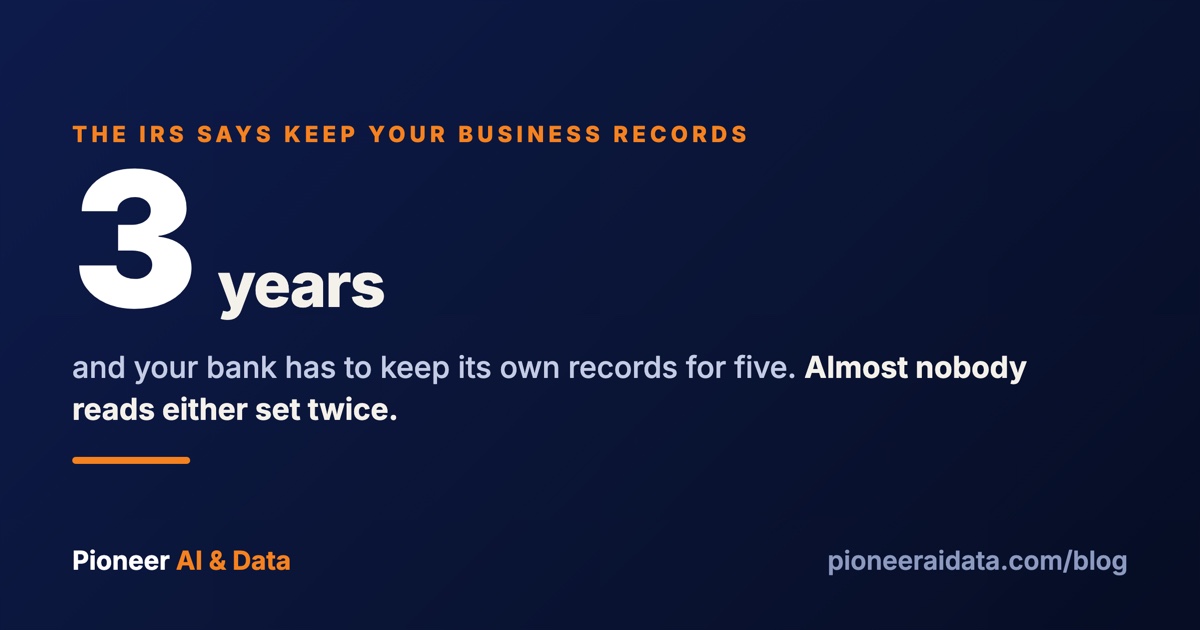
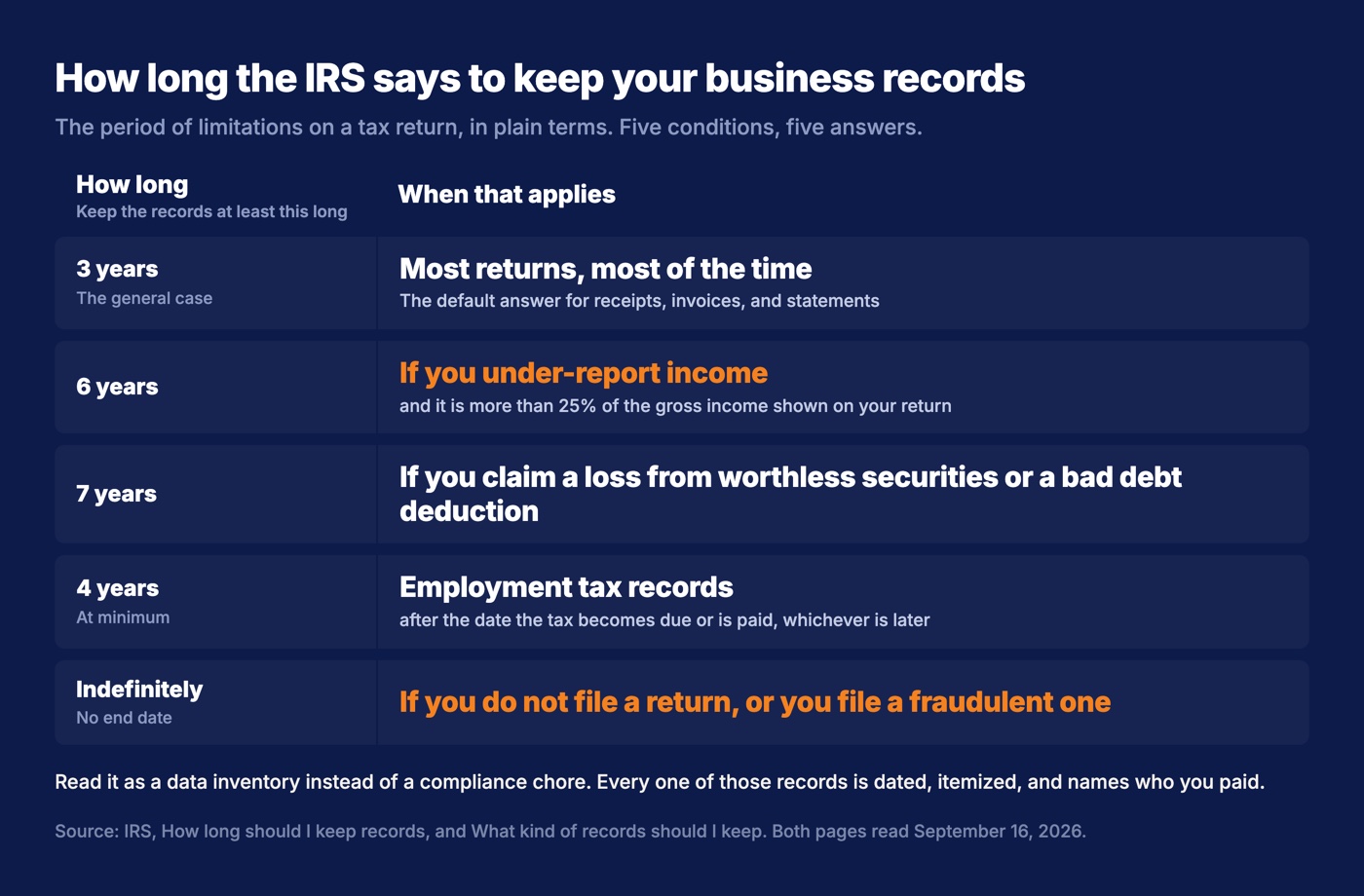
The IRS tells you to keep your business records for three years in the general case, and longer in several common ones. Six years if you under-report income by more than 25% of the gross income shown on your return. Seven years for a claim tied to worthless securities or a bad debt deduction. Employment tax records get at least four years after the tax is due or paid, whichever comes later. If you never filed a return, or filed a fraudulent one, the IRS says to keep the records indefinitely.
The same agency is specific about which documents. Gross receipts means cash register tapes, deposit information, receipt books, invoices, and Forms 1099-MISC. Purchases and expenses need documents showing "the payee, the amount paid, proof of payment, the date incurred." Assets need purchase and sales invoices and closing statements.
Read the IRS list again as a data inventory instead of a compliance chore. Every line on it is a dated, itemized record of money moving between your business and a named counterparty. A file like that is what most companies pay a consultant to build. You have been building one for years and filing it in a box.
Three places your business data is already sitting
Your records live in three places, and most owners only think about the first one. One pile is what you keep because the law says to: receipts, invoices, payroll records, tax returns. Another is held by somebody else on your behalf and handed over on request, which covers your bank, your card processor, your payroll provider, and your suppliers' order-history pages. The third pile is the one you made just by operating: quotes you emailed, job notes, scheduling history, the thread where a customer explained what went wrong.
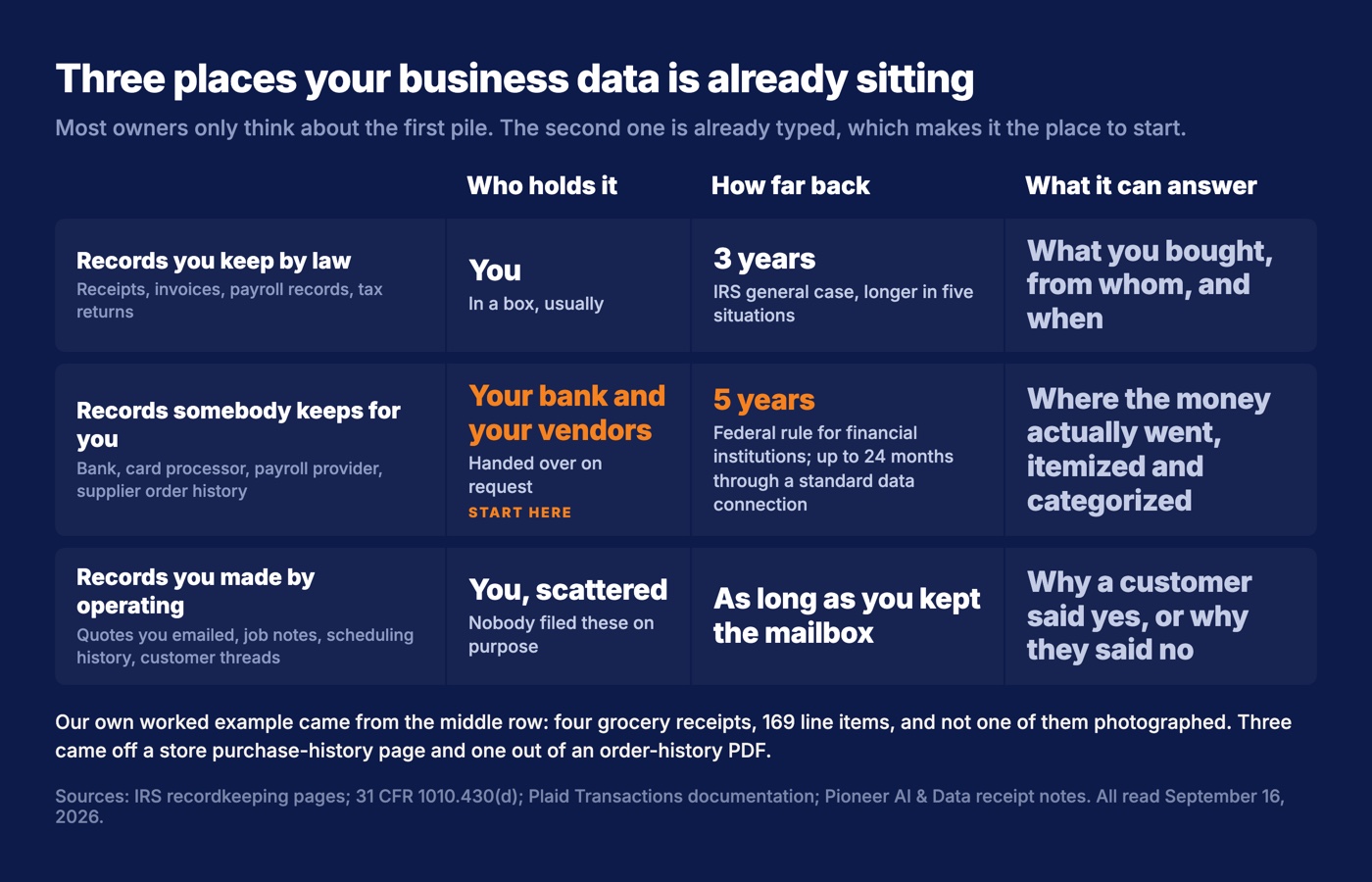
The second tier is the one worth checking first, because it is already typed. When we pulled four grocery receipts for an audit, not one of them got photographed. Three came off the store's purchase-history page and one came out of a warehouse club's order-history PDF. The retailer had already transcribed all 169 line items and stored them. The first question to ask any vendor portal is whether it has an export button, because the answer is usually yes and nobody ever looks.
Your bank has been itemizing everything for you
Your bank is keeping a cleaner record of your spending than you are. Federal anti-money-laundering rules require financial institutions to keep the transaction records they are obligated to create for five years, and to store them so they are "accessible within a reasonable period of time". Five years of retained records is not a courtesy, it is a legal obligation, and the history is sitting under your account number right now.
The standard bank-data connection that personal finance apps use can request up to 730 days of transaction history, about 24 months. Every transaction comes back with a date, an amount, and a description, plus a merchant name on 97% of them and a spending category on 95%. Connections keep every new transaction after that, so an account linked two years ago can hold roughly four years now.
We built our own books that way. The first pull covers thirty days, the rest of the history follows a few minutes later, and nobody typed in a single line of it. The whole thing runs on one machine and listens on nothing public, which matters more than the convenience does. If you are going to read your own financial records, decide where they are going to sit before you start.
What four of our own receipts said once somebody added them up
Four receipts held 169 line items, and nobody in the house had ever added them up. Two in-store trips two weeks apart came to $272.58, and roughly $97 of that, about 36%, was snacks, desserts, and drinks. Fruit was $41, about 15%, and stayed, because the kids eat it. We published the whole grocery breakdown with the household numbers left in.
Three findings came out of those four receipts, and not one of them is printed anywhere on a receipt.
- The coupons were working. Those two trips carried $20.18 and $13.65 in coupons and loyalty savings, and an earlier trip carried $29.95. The clipping was fine. What the cart was made of was the problem, and no coupon fixes composition.
- One receipt hid two businesses. A single $497.09 warehouse run was about $350 of food and about $138 of paper towels, soap, laundry pacs, and a fan. The food-and-household split appears nowhere on the receipt. It only exists once the lines are sorted into categories you chose.
- Two receipts beat one. Side by side, they showed Honeycrisp at $1.65 a pound in a 4 lb bag from the warehouse club and $2.69 to $2.78 a pound loose at the grocery store. Neither receipt says anything about the other store. The comparison is the finding.
Groceries are the low-stakes version of a business spend audit. Point the identical read at twelve months of supply orders, vendor invoices, or software renewals and nothing about the method changes.
Old records answer a different question than a dashboard does
A dashboard tells you what happened last week, and your records tell you what your business is made of. Composition, drift, and the category nobody owns do not show up in a weekly number, because a weekly number is already a summary of the thing you are trying to see.
Cost is the reason to do it this year in particular. In the Federal Reserve's 2026 Report on Employer Firms, built from 6,525 responses collected between September 3 and November 14, 2025, 77% of small employer firms reported rising costs of goods, services, or wages, or tariff-related cost challenges, or both. Rising costs are the top financial problem in the Fed's survey, and the file that explains where the money went is the invoice folder nobody opens.
Leaving the invoice folder closed is normal. Splunk puts 55% of an organization's data in the category it calls dark, meaning untapped, hidden, or unknown. Small businesses are not the exception to the 55%, they are where the number runs worst, because no small company has an analyst on staff whose job is to go looking.
The folder stays closed because the work is boring, not because it is hard. Reading 169 line items takes patience rather than skill, and a busy owner will never get to the bottom of it. Tedious work with a clear right answer is exactly what a machine is for.
Where reading your own records goes wrong
The transcription is the part that fails, not the analysis. On a benchmark of 10,656 real receipt images published in May 2026, the top scorer was a model the researchers had fine-tuned on receipts, at 0.7950 on the paper's overall accuracy measure. The best off-the-shelf model scored 0.7373, and off-the-shelf is the tier you will be working in.
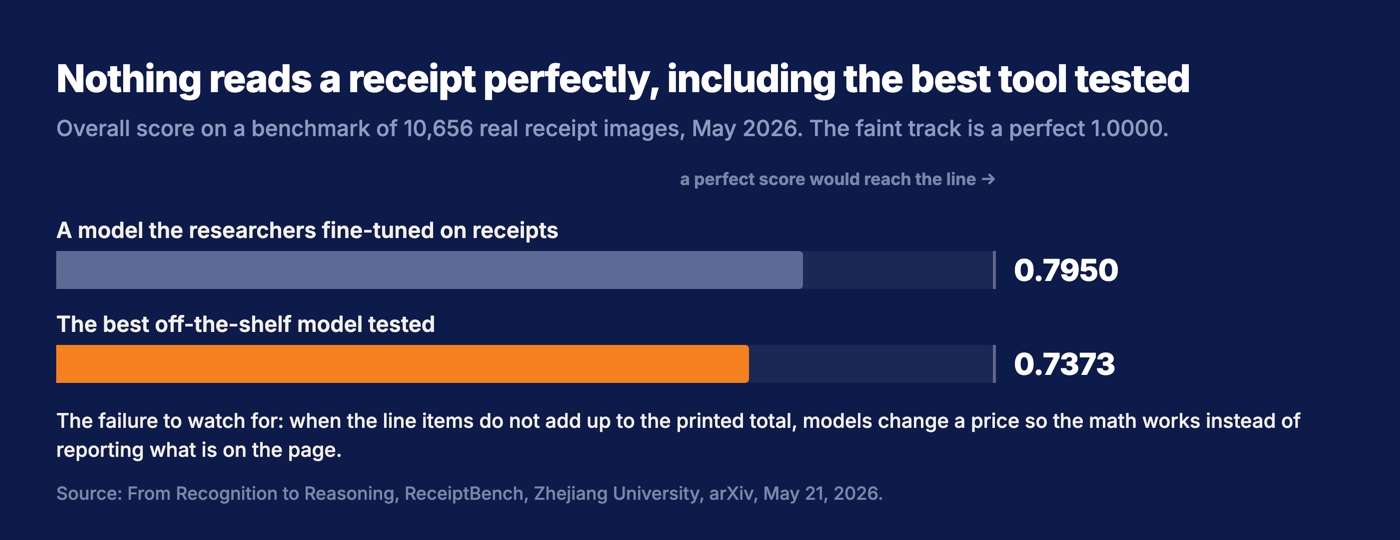
One failure in the receipt benchmark deserves its own warning. The researchers named a pattern they call hallucination for arithmetic consistency: when the line items do not add up to the printed total, the model changes a price so the math works. It does not flag the mismatch, it silently fixes it. The same paper found invoice numbers the single most error-prone field, with digits like 1 and 7 confused in dense layouts.
So the rule is: get the lines transcribed first, check four or five of them against the paper yourself, and never let the tool reconcile a total you have not verified. If the transcription is wrong, every percentage downstream is wrong and it will look completely reasonable.
Two more limits. Four receipts is a shape, not a result, so nobody should rebuild a budget or drop a supplier on one afternoon of reading. And strip the card and account numbers off everything before it gets uploaded, then decide where the file lives when you are done.
Read one folder of your own records this week
One folder and one question is the whole setup.
- Download twelve months of one thing. Vendor invoices, card statements, or your supplier's order history. Use the export button rather than a scanner if the export exists, because typed records beat photographed ones every time.
- Ask for line items before you ask for advice. Have the AI transcribe every line with its date, amount, and payee into a plain list. Spot-check five lines against the original.
- Sort those lines into your categories, not its categories. Yours are the ones that match how you actually run the place. Then ask for the dollar total and the percentage of the whole for each one.
- Ask what it would cut and what it would protect. The protect half is what keeps the exercise from becoming an across-the-board trim that breaks something you needed.
- Change one thing. One change that survives the quarter beats five that do not.
An afternoon of reading your own records costs nothing but the afternoon, which is why it belongs before any purchase. Once the same read is worth running every month, a recurring report starts earning its cost, and knowing what this kind of work actually runs starts to matter.
Your competitors can buy the same software you can. None of them can buy your three years of invoices.
Want this run for your business?
Book a free discovery call. We map where AI fits, show you the numbers, and point you to the right plan. No pressure, no jargon.
Book a Discovery Call →