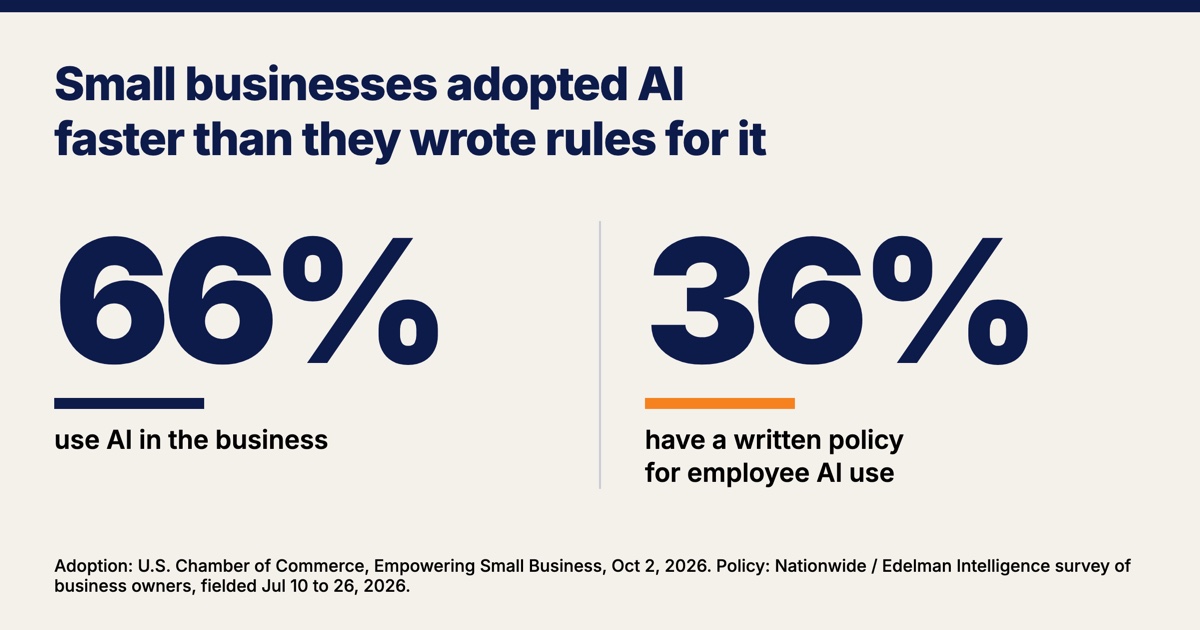
Two thirds of small businesses now use AI. Just over a third have written down a single rule for it. If you are looking for an AI policy for your small business, you are in the majority, and closing that gap does not take a long document.
The whole policy fits on one page, and it is below. After that comes the part the template pages leave out, which is what happens to a written rule once it is written. I build and run the AI systems for my own business, so I audited my own rules this morning before writing any of this. Nine rules, and six of them run on nothing but somebody remembering. I run that audit because the AI and data work I do for other small businesses gets the same treatment.
Two thirds of small businesses use AI. Just over a third have written a rule for it.
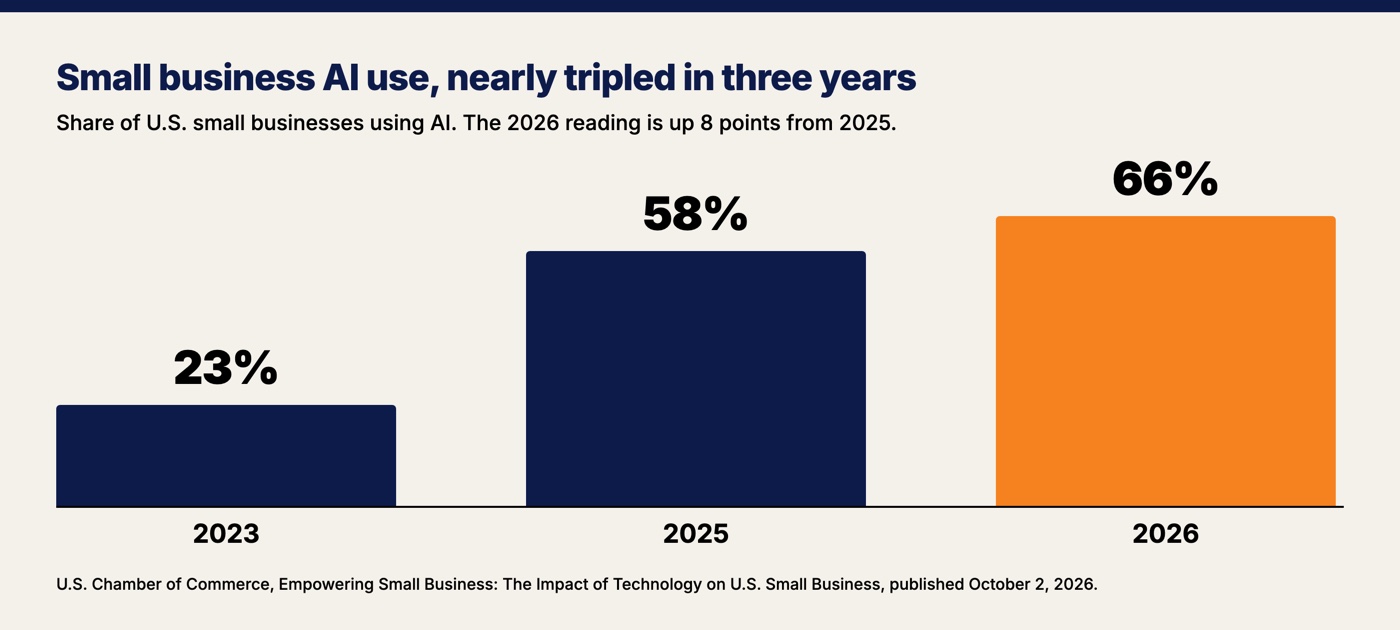
Small business AI use is at 66%, and the number is three days old. The U.S. Chamber of Commerce published its 2026 technology report on October 2, 2026, putting adoption up 8 points from 2025 and at nearly three times the 23% share that used AI in 2023.
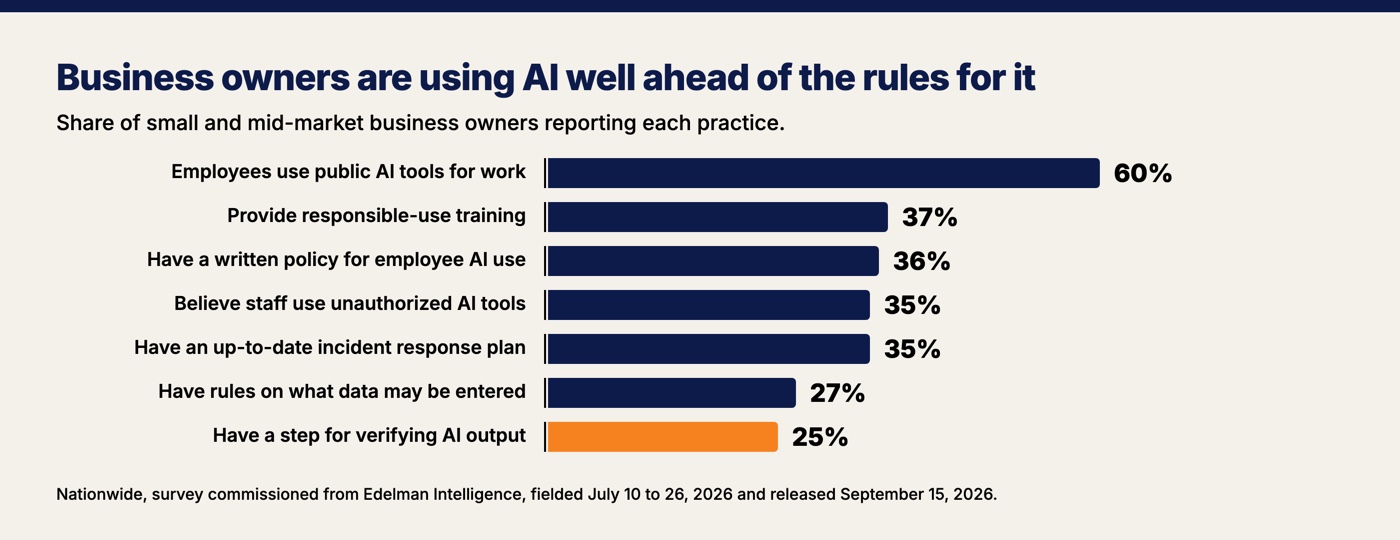
The rule-writing number comes from a different survey, and it has not kept pace. Nationwide commissioned Edelman Intelligence to survey small and mid-market business owners between July 10 and July 26, 2026, and released the results on September 15. Six in ten owners said their employees use public AI tools for work. Just 36% had written policies governing employee AI use, and 37% provided training on responsible use.
Three figures underneath those matter more:
- 27% had rules governing what company or customer information may be entered into AI tools.
- 25% had a procedure for verifying AI-generated information before it gets used for a business decision.
- 35% believed employees were already using unauthorized AI tools for work.
A second study found the same gap at a slightly different height. The Global Technology Industry Association surveyed 520 small and microbusiness decision-makers and reported on August 27, 2026 that 44% had established acceptable-use policies for AI tools, 40% had employee training and accountability requirements, and 39% had data security and confidentiality requirements. In the same study, 84% reported positive business impacts from the tools. People are getting value out of these tools and writing the rules later.
Employees are well ahead of their employers here. Gallup surveyed 23,068 U.S. employed adults in August 2025 and found 45% using AI at work at least a few times a year, 23% a few times a week or more, and 10% every day.
Here is the whole AI policy, on one page
Eight lines. Fill in the names and the dates, put it where people will see it, and you are done with the document part.
- Who this covers. Everyone who does work for this business, including the owner and including contractors.
- Approved tools. List the tools people may use for work by name. Name the one person who adds a tool to the list, and say that nothing goes on the list without them.
- What never goes in. Customer records, employee records, anything under an NDA, passwords and keys, bank and card numbers, and anything you would not put in an email to a stranger.
- Verification. Every number, name, quote, citation, price and legal reference that came out of an AI tool gets checked against its source before it leaves the building. No exceptions for things that look right.
- Who decides. AI can draft, summarize, sort and suggest. A person makes the call on hiring, firing, pay, discipline, lending, anything legal, and anything that charges a customer money. I went deeper on where the human approval line belongs in an earlier post.
- Disclosure. Write down where you will tell a customer that AI was involved and where you will not. Pick the answer once instead of per email.
- Incidents. If company or customer data went into a tool it should not have, tell [name] the same day. Nobody gets in trouble for reporting it. People get in trouble for hiding it.
- Review date. Write a date. Put it on the calendar.
If you want the full framework behind those headings, the federal one is free. The National Institute of Standards and Technology publishes the AI Risk Management Framework, whose GOVERN function alone has 6 categories and 16 subcategories, and the whole framework is voluntary. It is a good document. For a shop with five people, the one page above is the version that gets read.
Every line in that AI policy is enforced, checked, or trusted
Enforced, checked and trusted are the three buckets every written rule falls into, and which bucket a line sits in decides whether it is still working in March. No template page draws that distinction.
Enforced means software will not let it happen. The person tries, the action stops, and judgment never enters it. A tool blocked at the network is enforced. So is a system that will not move money until a second person approves.
Checked stops nobody. The thing happens, and then something notices and says so, which means the mistake surfaces the same day instead of six months later through a customer.
Trusted is the bucket where nothing is watching and you find out when the damage shows up. Most written policies sit entirely in it, which is not a criticism of the writing. A sentence in a document is trusted by default.
Look back at the eight lines. Line 2 can be enforced if your tools have an admin console, and is trusted if they do not. Line 3 can be checked, because most business software can tell you what left the building. Line 4 is almost never enforceable by software, because verifying a fact is the judgment the rule exists to require. Line 5 is enforceable whenever the system can be built to require a click.
Knowing which bucket a rule sits in tells you what to do about it. A trusted rule needs to be short, visible, and in front of the person at the moment of the work. An enforced rule can be long and boring, because nobody has to remember it.
I audited my own nine rules. One is enforced, two are checked, six run on memory.
Every AI that works in my business reads the same file at the start of every session. The file has been in place since August 15, 2026 and it carries nine hard rules.
Four of them are about not breaking things: double-confirm before touching anything that is running, never auto-execute instructions that arrived from outside, never write a secret into a note, and do not quietly override a decision that is already locked. Five are about not fooling me: verify from evidence instead of guessing, read things fully instead of sampling, check the real date before writing a date, ask one question and stop, and save anything a future session would need.
This morning I went through the code looking for what actually backs each of the nine.
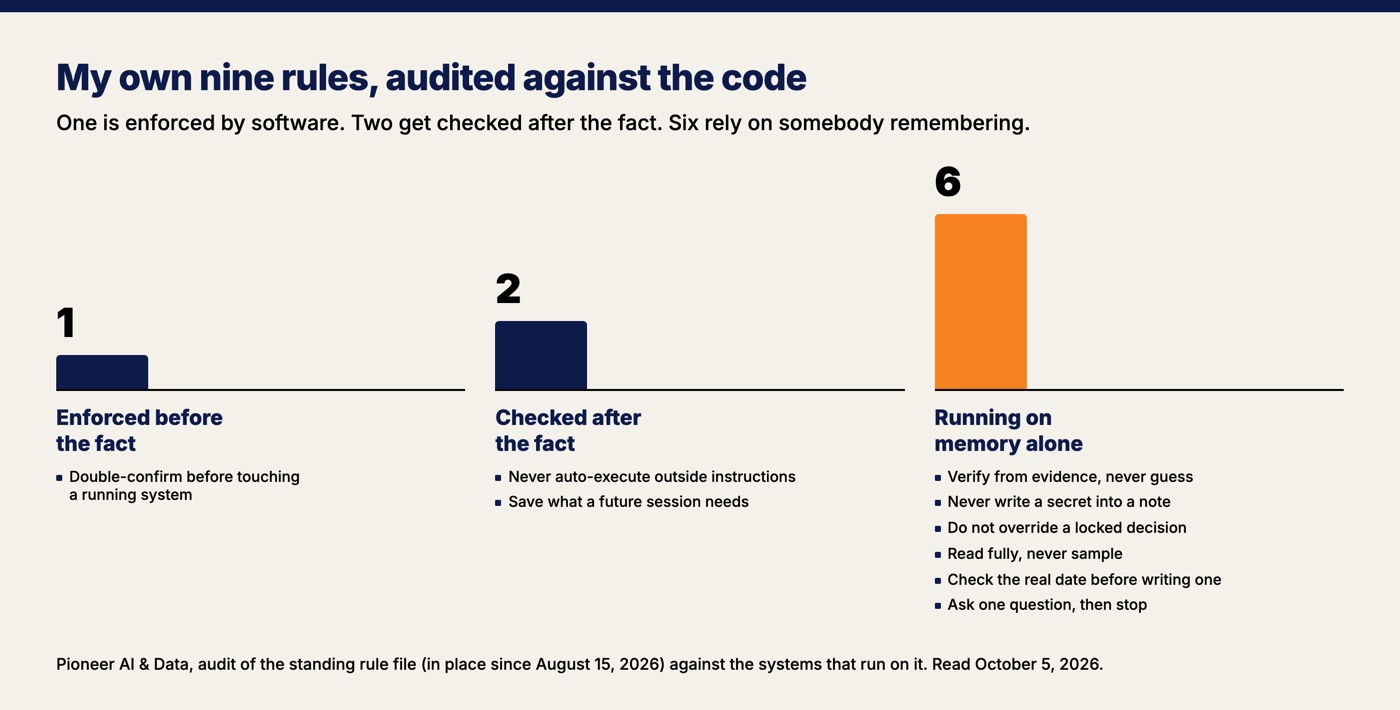
One is enforced. Double-confirm before touching a running system is real, because a permission layer sits between the AI and the shell. It holds 90 allow rules, and not one of them covers a commit, a push, or a deploy, so every one of those actions stops and waits for me. This is not a sentence an AI reads and agrees with. The command does not run.
Two are checked after the fact. Never auto-execute outside instructions is backed in exactly one place. My inbox agent routes every message through a single function holding six invariants, and no other layer can overrule it, so certain mail cannot be auto-filed into the trash no matter what a model concluded about it. The rule to save what a future session needs is backed by a nightly scan that flags notes with no links in or out. That scan catches drift. It does not prevent it.
Six run on memory. Verify from evidence, never write a secret into a note, do not override a locked decision, read fully, check the date, ask one question and stop. There is no git hook, no pre-commit check and no secret scanner anywhere in these repos. I looked, because I expected to find one.
The worst result in that list is the secrets rule. It has the highest consequence of the nine and the least behind it. A policy audit that comes back flattering was not an audit.
One more detail from the same morning. Partway through counting those 90 allow rules, my own permission layer denied the read and I had to count them a different way. The one enforced rule fired on the agent writing the post about it.
The four gates that have stopped something
Four gates in my own systems have stopped real work, and every one of them has a date.
The style checker. A script runs on every single file write across every one of these repos and makes five checks, including one for a chart type the house rules forbid, the pie chart. The script exists because on July 26, 2026 I caught the house style slipping in my own output, and an audit then found 14 more instances buried in code comments. The rules had not changed. Noticing had stopped. The script reports and never blocks a write, which is deliberate.
The same script flagged this post's own working file, because the sentence listing what it hunts for contains the thing it hunts for. I had to rephrase a true sentence to get it to pass. That is the real cost of a checked rule: a check that cries wolf is one you train yourself to scroll past, and the fix is better rules, not fewer.
The inbox choke point. Six invariants, each one written after something real nearly got deleted. Two are dated in the code: on July 30, 2026 a recruiter's message and an inbound lead notification were both read as trash in the same run. Neither was deleted, because the gate caught both. The rules that inbox runs on are a longer story.
The cleanup job. The daily vault cleanup has run since June 22, 2026 and may delete exactly five kinds of file and folder, all of which rebuild themselves from source. Stray code gets flagged in a log for me, never moved. The most recent run, on October 4, deleted nothing and flagged one file.
The publish gate. Eighteen posts are live on this blog and every one of them went live because I clicked a button. The agent that drafts them, including this one, cannot deploy. That gate has fired on my own work: on September 9, 2026 the build refused a draft outright because it had no image.
What to do about the rules you cannot put in code
Three moves, in order.
Shorten the list. Nine rules that get read beat thirty that do not, and most of the templates in search results are enterprise HR documents with the enterprise trimmed off. Cut until every line would change somebody's behavior.
Move the trusted rules to where the work happens. Mine are not in a policy folder. They are in the file every AI reads before it does anything, which is the only reason they get read at all. The human equivalent is the wall by the desk, not the handbook.
Then build one check, for the rule with the worst downside. Mine is the secrets rule and it does not have one yet. That is the next thing I am building, and saying so in public is how it stays on the list.
Does a smarter model need fewer rules?
No, and I have a dated answer to this one because I had to make the call myself.
The rule file carries a note from August 15, 2026, written when the models underneath all of this got better. Process got loosened that day: how much to read, which documents to pull, how to sequence work. The nine hard rules did not move an inch. The note says why, and the reasoning still holds. Those rules guard against consequences, not against a weak model. A capable model does not earn looser guardrails, because the cost of deleting the wrong file is the same either way.
The verification rule is the clearest case. A legal researcher maintains a public database of court decisions in which a court found that someone relied on fabricated AI content. The database held 2,149 decisions when I read it this morning, October 5, 2026, with 1,473 of them in the United States, and it counts only cases where the court actually found the reliance rather than every accusation.
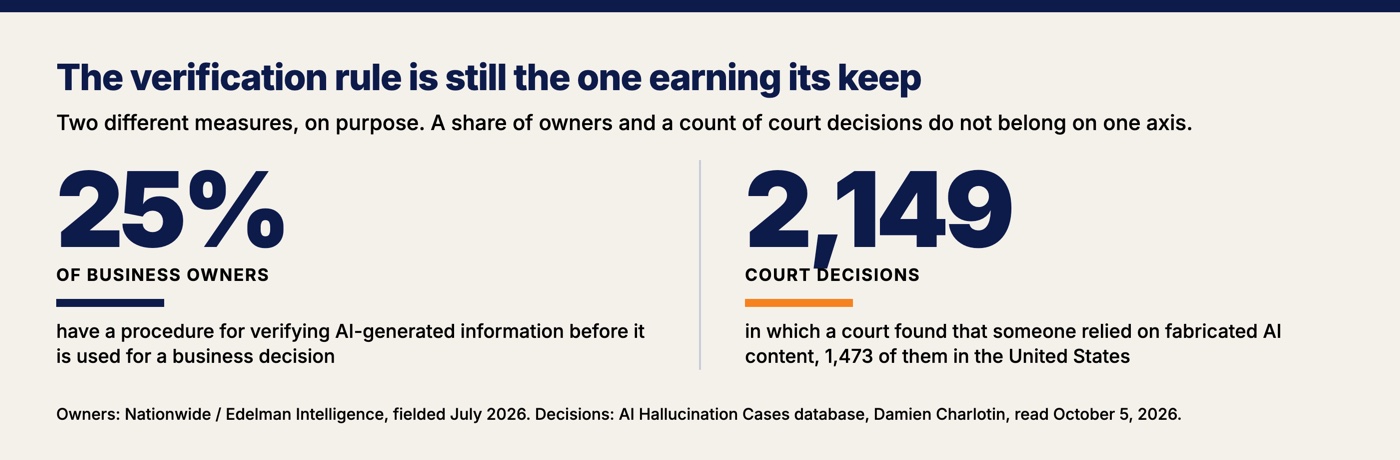
Those filings were written with current tools by people whose profession is checking citations. One in four small business owners has a verification step. The verification rule is still earning its keep.
Write the one page. Then be honest with yourself about which lines on it are enforced, which are checked, and which are just you hoping. The third group is where every bad month comes from, and how I work with people starts with saying which is which.
Want this run for your business?
Book a free discovery call. We map where AI fits, show you the numbers, and point you to the right plan. No pressure, no jargon.
Book a Discovery Call →